
The book is out. As of yesterday morning, unBiblical Eldership: Recognizing the quiet failure of church leadership — and recovering from it is no longer something I am writing. It is something you can hold.
I have spent two weeks preparing you for this day. Two weeks ago I told you why I wrote a book I did not want to write. Last week I stepped aside and let the opening chapter speak for itself. Today the book can speak to anyone who opens it, which means my part of the telling is almost done. But there is one thing left to say, and I want to say it before you read a single page. It is not about what the book argues. It is about where it was written from.
A book about the failure of church leadership can be written from several places. It can be written from above—the expert looking down, sorting the qualified from the unqualified. It can be written from across the room—the prosecutor, building a case against the men who caused the pain. I understand the pull of both places. I have felt it.
This book was written from neither. It was written from beside you.
The One and the Ninety-Nine
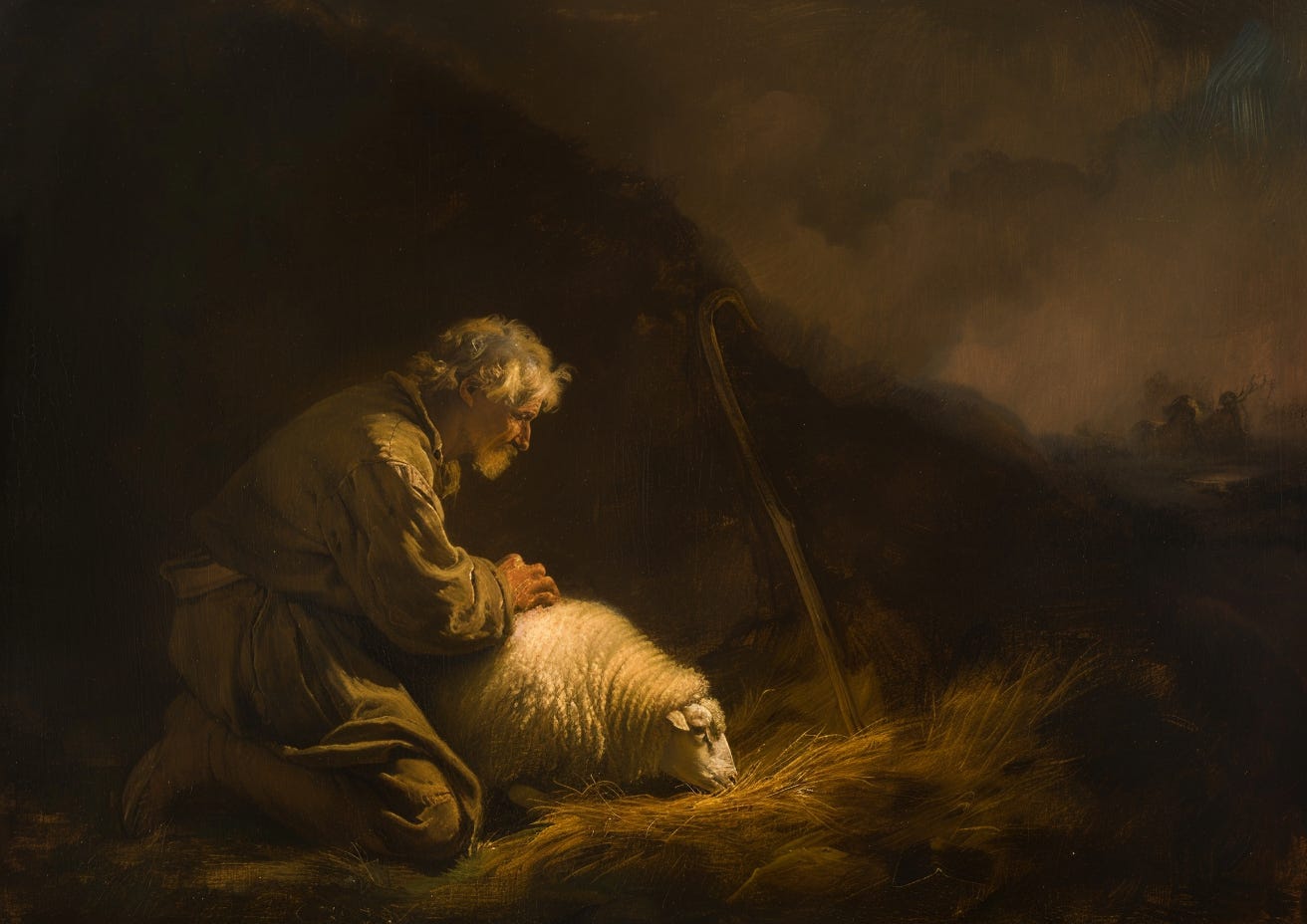
Jesus once answered His critics with a question about sheep. “What man of you, having a hundred sheep, if he has lost one of them, does not leave the ninety-nine in the open country, and go after the one that is lost, until he finds it? And when he has found it, he lays it on his shoulders, rejoicing. And when he comes home, he calls together his friends and his neighbors, saying to them, ‘Rejoice with me, for I have found my sheep that was lost’” (Luke 15:4–6 ESV).
He told that parable to defend His welcome of lost sinners, and that is its home ground: heaven’s joy over one who repents. But stay a moment with the shape of the heart it reveals. This shepherd counts. He notices one missing out of a hundred. He goes himself; he does not send. He searches until he finds, not until it stops being convenient. And the search ends on his shoulders, in rejoicing—not in a lecture about wandering off.
Notice, too, what the parable does not say. It does not say the ninety-nine stopped mattering. They are in the open country, still his, still counted, and he comes home to them. The going after the one is not the neglect of the many. In this Shepherd’s arithmetic, nobody is lost in the rounding.
I open here because everyone who picks up this book will come to it standing somewhere in that field. Some of you come as the one—hurt in a place the room never went looking. Some of you come as the ninety-nine—still in the fold, not entirely sure what all the searching is about. The book was written with both of you in the room, and I want to open both doors properly, because behind them you need different things.
If You Have Sat in a Pew
One of you has sat in a pew and watched something go wrong. You could not always prove it. You saw the drift before you had words for it, the way you can smell rain before it falls. You raised it, carefully, the way you had been taught to. And somewhere along the way you were told—perhaps gently, perhaps not—that the trouble was your own heart. Maybe you left. Maybe you are still there, quieter than you used to be.
The book’s first job, for you, is to tell you honestly what you saw. Not to reopen the wound for the sake of the reopening, and not to hand you ammunition—but to give the quiet wrongness its name. Naming, for a wounded reader, is a kind of medicine. It settles the question you have carried longest: whether the problem was really you. And the book asks nothing of you it has no right to ask. It does not send you back into any room that hurt you. It walks you toward the Shepherd who comes looking, and it lets Him set the pace.
If You Sit at a Table
The other of you sits where I sat, at a table where decisions about a flock get made. Nothing has collapsed. The men around you are good men; some of them are your friends. But something in the room has begun to trouble you, and you cannot put a name to it, and you are not certain whether naming it would help anything or only cost you.
The book asks more of you than it asks of anyone, and I want to be straight about that. You are the one who can act. But hear what it does not do. It does not hand you a verdict on the men beside you, and it does not deputize you to deliver one. It teaches you to see—your room, and yourself in it—and then it hands you a repair that begins, as all real repair does, closest to home.
And I know what you may be bracing for. A book with this title, written by a man who carries a wound from a leadership table, sounds like it might be an ambush. So let me tell you plainly what it is not.
What the Book Is Not
It is not an exposé. You will find no church named in it, and no person. Not because there is nothing that could be told, but because telling it is not the point, and those wounds are not mine to publicize. The experience in it is real and the particulars are composite, on purpose, so the book can be handed from one believer to another without becoming a weapon in anyone’s hand. I did not write it to put anyone on trial. The first man it examines is me.
And it is not an alarm. I am not trying to frighten anyone toward the worst case. The book is about the early, quiet signs—the kind of thing that looks entirely fine for years before it does not—because what is seen early is most easily healed. The reason to read it is hope, not dread.
Where It Was Written From
For more than twenty-three years I served as a lay elder. I sat at the table. I loved the men around it, and I drifted with the room, and I carry a wound from those years that I have chosen not to describe, except to say that it was handed to me by people I served beside. The years since have gone to learning what I should have seen sooner, and the book is what that learning became.
The preface opens with the truest thing I know to tell you about its author: “I am not above the table. I am at it—or I was. I am not the doctor. I am a patient.” And a few lines later comes the sentence the whole book answers to: “Whatever correction is in these pages, I am the first one it corrects.”
That is what from beside you means. Not a credential looking down. Not a case being built. A fellow sheep, walking next to you toward the Shepherd, holding a lamp up to a stretch of path where he himself once lost the way.
The Question Underneath
There is one question beneath every chapter, and I hope you will carry it with you if you read: how do good men—men who love Scripture, who can teach it and defend it—drift into leading Christ’s Church in ways Scripture would not recognize? For years I assumed the answer had to be hypocrisy, or hidden sin, or incompetence. I no longer believe that. The answer the book keeps finding is quieter and harder: a man can hold the office while quietly losing the life it requires. The cure was never a better method. The cure is a life kept near the One the office exists to serve.
The Verse That Opens the Book
Before the book says a word of its own, it opens with the verse everything in it stands under:
“shepherd the flock of God that is among you, exercising oversight, not under compulsion, but willingly, as God would have you; not for shameful gain, but eagerly; not domineering over those in your charge, but being examples to the flock. And when the chief Shepherd appears, you will receive the unfading crown of glory.” (1 Peter 5:2–4 ESV)
Every human shepherd in that verse is an undershepherd. The flock is God’s flock, among them but never theirs. The manner is prescribed—willing, eager, an example, never domineering. And the last word belongs to the Chief Shepherd, who appears, and who crowns. Everything the book diagnoses is some quiet departure from that verse. Everything it commends is a way back under it.
The Book, and Where to Find It
unBiblical Eldership is available now, in hardcover, paperback, and ebook: amazon.com. Two companion guides released alongside it—a Study Guide written for church members, and a Discussion Guide written for elder boards—for readers who want to walk the book with others.
If the book sounds as though it was written for you, it was. That is the whole ask, and it is the only one I will make today.
Take Your Place in the Flock
And if you never read a page of it, this last word is still yours.
The Shepherd of Luke 15 has not changed. He still counts. He still notices one missing out of a hundred. He still goes Himself, and searches until, and carries home on His own shoulders, rejoicing. If you are the one, hurt in a place no one came looking—He is not the leadership that failed you, and He is still looking. If you are the ninety-nine, safe and a little unsure what all the searching is about—you were never forgotten in the open country, and you never will be.
The book was written from beside you. But the Shepherd does something better than write. He comes. Take your place in the flock, wherever you have been standing. He knows the way to where you are.