
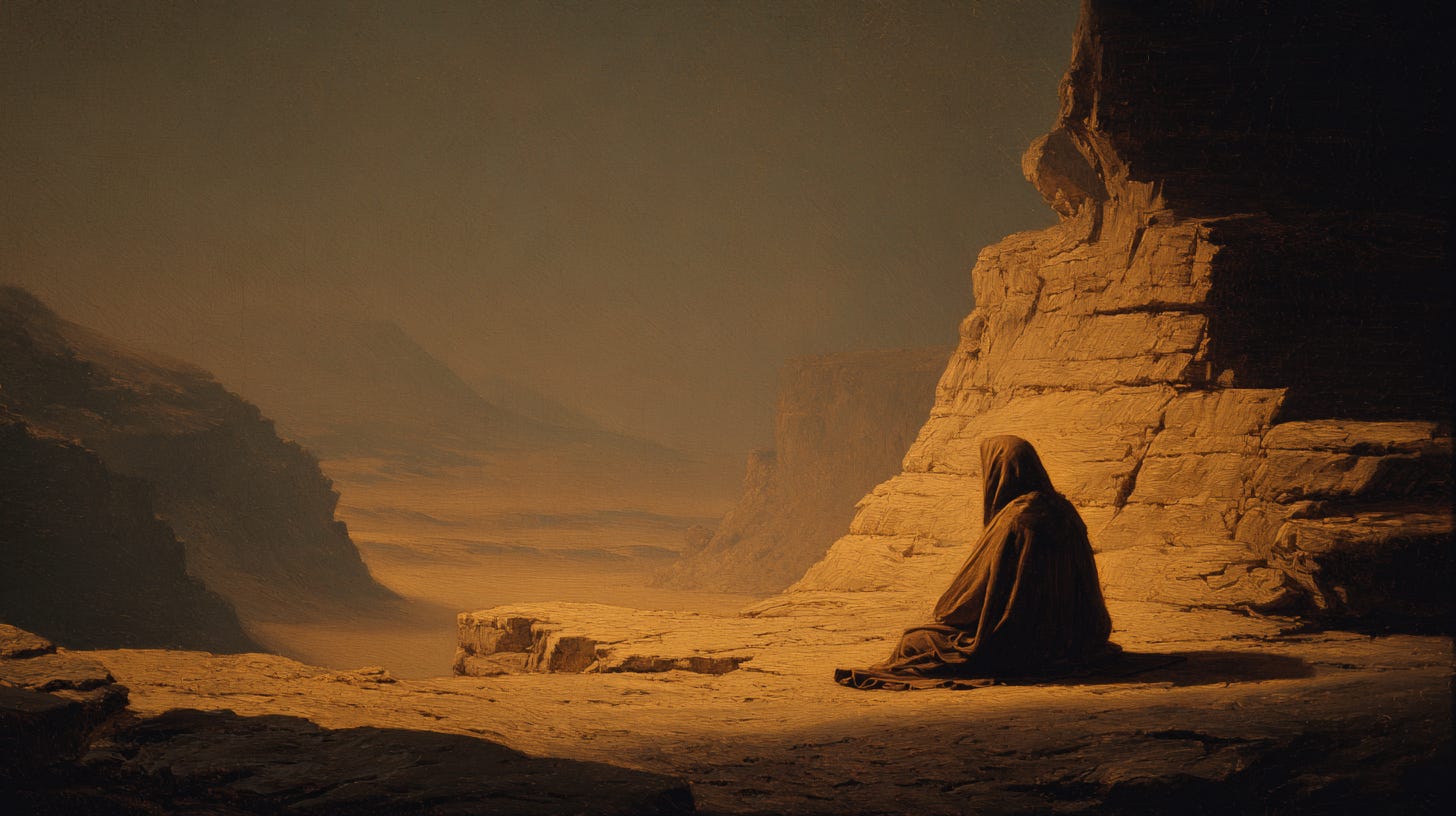
There is a line in Paul’s letter to the Galatians that most of us read straight past.
We slow down for the conversion. The road to Damascus, the light from heaven, the voice, the blindness, the scales that fall from his eyes. That part we know by heart. And we slow down again for the journeys, the letters, the beatings and the shipwrecks, the churches planted across the empire. The violent beginning and the tireless work. Those are the parts of Paul we tell and retell.
But between them is a sentence we tend to step over without noticing it is there.
But when he who had set me apart before I was born, and who called me by his grace, was pleased to reveal his Son to me, in order that I might preach him among the Gentiles, I did not immediately consult with anyone; nor did I go up to Jerusalem to those who were apostles before me, but I went away into Arabia, and returned again to Damascus. (Galatians 1:15-17, ESV)
He went away into Arabia.
Paul is in the middle of an argument when he writes this. He is defending where his gospel came from, insisting he did not receive it secondhand, that no committee in Jerusalem handed him his commission and sent him out with their approval stamped on it. And so he tells the Galatians what he did first, in the days right after the risen Christ was revealed to him. He did not consult anyone. He did not hurry to the apostles to be recognized. He went into the desert.
We are not told what happened there. Paul does not narrate it for us. He gives us a place, and then, a few verses later and almost in passing, the length of the silence:
Then after three years I went up to Jerusalem to visit Cephas and remained with him fifteen days. (Galatians 1:18, ESV)
Three years. Three years stood between the encounter and the visit to Jerusalem, much of it spent in Arabia, before the man who would carry the gospel to the nations sat down with the leaders of the Church.
Consider what that withdrawal must have cost a man like Paul.
Here was the most capable man imaginable for the work. Trained under Gamaliel. Fluent in the Scriptures. Fierce, gifted, utterly convinced. He had just met the living Christ. If anyone has ever been ready to begin at once, surely it was this man, on this morning, with this fire in him. Every instinct we carry would have rushed him to a platform. The harvest is plentiful. The need is urgent. Why wait?
And yet he went away into Arabia.
Because the encounter is not the same as the formation.
Seeing the risen Christ made Paul a believer. It did not, by itself, make him a shepherd. There is a difference between being called and being formed for the calling, and the wilderness is where that difference gets done. Paul needed time being with Christ before he was sent for Christ. The zeal had to be reshaped into something that could last a lifetime and survive a beating. The man had to be remade before the message could be trusted to him.
The desert has always been where God does this work.
It was in Midian, tending another man’s flock, that Moses spent forty hidden years before a bush burned and a nation was set free. It was in the wilderness that Israel was formed into a people. It was at Horeb, after the wind and the earthquake and the fire, that Elijah heard the low whisper that all that noise could never have carried. And it was into the wilderness that the Spirit drove our Lord himself, for forty days, before a single word of public ministry was spoken. Arabia is not a detour from the calling. Arabia is the country where callings are made.
We have nearly lost this.
The pattern we have built runs the other way. We credential first and form later, if we form at all. We see a gifted man, an able man, a man who is present and willing and persuasive, and we mistake his gifting for his readiness. We mistake the encounter for the formation. A man is zealous, so we hand him authority. A man is capable, so we put him on the board. We skip the years in Arabia because Arabia produces nothing we can measure, and we are a people who trust what we can measure.
But the most important shaping a shepherd ever receives happens precisely where nothing can be measured. It happens in the unseen season, the unrewarded stretch, the long quiet before anyone is watching. It happens in Arabia, where there is no audience to perform for, no office to protect, and no one keeping score. A man learns there whether he wants Christ or wants to be seen leading for Christ. That is not a small thing to learn. It cannot be learned on a platform. It can only be learned in the desert.
A local church that rushes its most gifted members into eldership, skipping the formation because the gifting is so obvious and the need is so real, is building on the encounter without the Arabia. It may work for a while. Gifting carries a man a long way. But gifting was never meant to carry the weight that only formation can bear, and when the pressure finally comes, and it always comes, the difference between the two becomes the whole story.
So I want to say something to the one reading this who is in a wilderness right now.
Perhaps you are in a season where nothing seems to be happening. No title. No platform. No visible fruit. Maybe you have been set aside, or passed over, or simply left to wait, and you have begun to wonder whether the waiting is a sign that the calling was never real.
Do not despise your Arabia.
The withdrawal is not the delay before the work. Very often the withdrawal is the work, the leadership work that has to be done before any of the visible work can begin. The Shepherd is doing in the silence what no platform could ever do in you. He is forming a man who can be trusted with a flock. He is teaching you, where no one can see, the only lesson that finally matters, which is how to be with him.
Paul went away into Arabia. And when he came back, he was ready in a way that no commission from Jerusalem could have made him.
The desert is not empty. It is where the shepherd is made.