
You can be standing in the parking lot, engine still running, and not be able to make yourself walk in.
The building is unfamiliar. Nobody inside knows your name or your history. On paper it is the safest a church could possibly be for you — no one there was in the room when it happened. And still your hands stay on the wheel. Because the last time you gave a body of believers your trust, that trust became the very thing that was used against you. The place that was supposed to be the safest place you knew turned out to be where the deepest wound was made. So now the sanctuary doors read like a warning, and the pews look less like a home than like a risk you have already taken once and cannot quite afford to take again.
If that is you, I want to say at the very start that what you are feeling is not cowardice, and it is not a small faith. It is a wound doing exactly what wounds do. A body that has been burned pulls back from heat. That is not a character flaw. It is the nervous system working the way God built it to work. The instinct to protect yourself from a second version of the first injury is not the enemy of faith. It is evidence that the first injury was real.
But I do not want to leave you in the parking lot. Because Scripture has a road that leads back, and it does not begin where you might expect. It begins with two people walking the other way.
They Were Walking Away
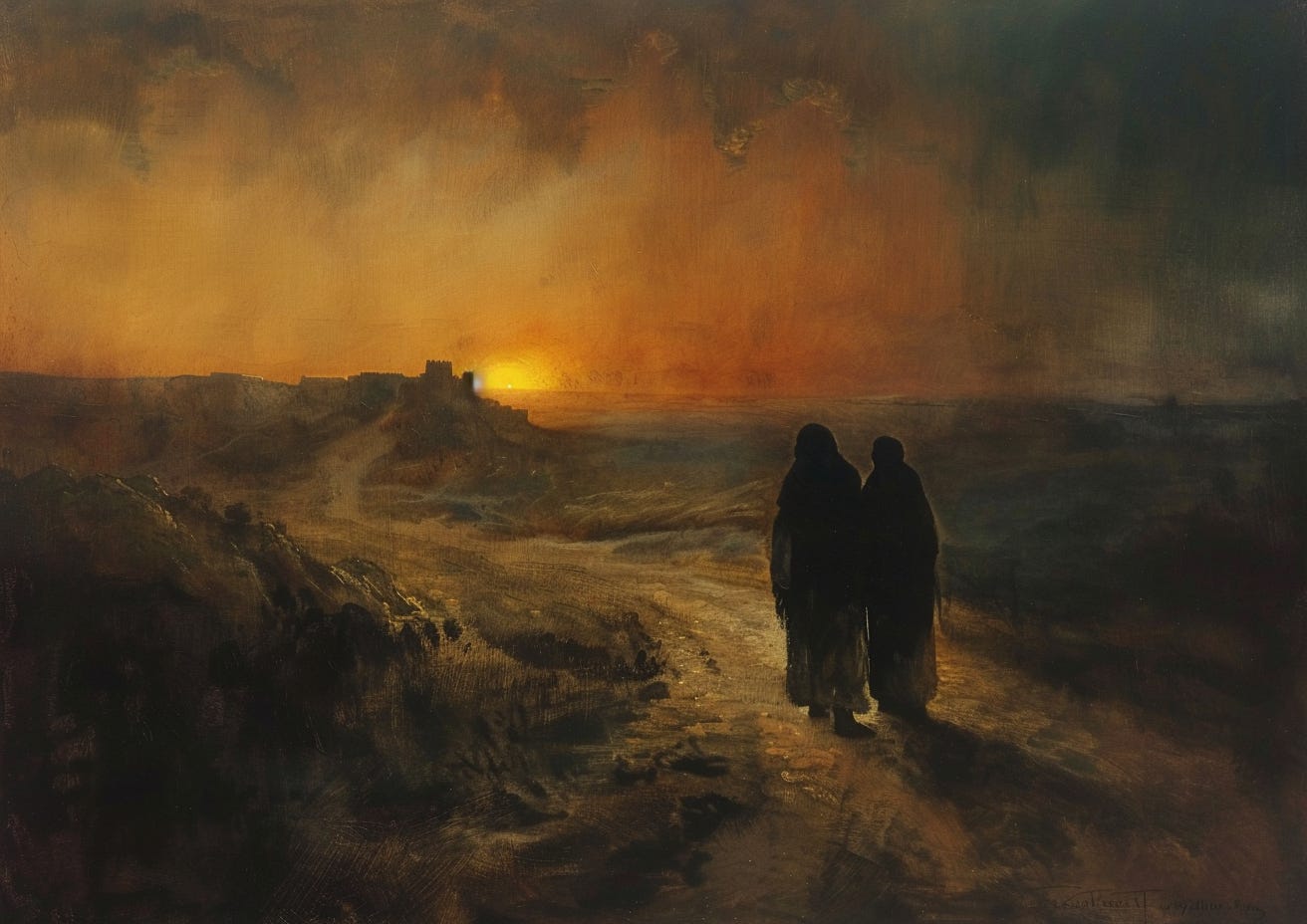
On the afternoon of the first Easter, two of Jesus’s followers were leaving Jerusalem. Not going to worship. Leaving. Walking out of the city where everything they had believed in had just collapsed, heading for a village called Emmaus, seven miles down the road and away.
“That very day two of them were going to a village named Emmaus, about seven miles from Jerusalem, and they were talking with each other about all these things that had happened” (Luke 24:13-14, ESV).
Sit with the direction of their feet. The community they had belonged to was in ruins. The leader they had staked everything on was dead. The gathered disciples were somewhere behind them, hiding behind locked doors, and these two were done. They had their reasons, and their reasons were good ones. They had watched the thing they loved most be destroyed by the very people who were supposed to guard it. So they were walking away, and who could blame them.
And here is the first thing the story does, before it does anything else. It tells you where Jesus was.
“While they were talking and discussing together, Jesus himself drew near and went with them” (Luke 24:15, ESV).
He did not wait for them at the temple. He did not stand at the door of the gathered church with His arms crossed, waiting to see whether they would come to their senses and turn around. He met them on the road away. He drew near to the ones who were leaving, and He fell into step beside them, walking their direction, at their pace, in the middle of their retreat. Before there is any word in this story about returning, there is this: the risen Christ walks the road away with the ones who cannot stay.
He Did Not Shame the Leaving
Watch how He treats them once He is beside them, because it is the opposite of everything the wounded have been trained to expect from a religious voice.
“And he said to them, ‘What is this conversation that you are holding with each other as you walk?’ And they stood still, looking sad” (Luke 24:17, ESV).
He asks. He does not announce. He does not open with a correction or a diagnosis of their unbelief. He asks them what they are carrying, and then He does something even more remarkable — He lets them tell Him. One of them, Cleopas, actually rebukes the stranger for not knowing what everyone knows, and Jesus, who knows better than anyone alive what happened in Jerusalem, simply says:
“What things?” (Luke 24:19, ESV).
And He stands there and lets them pour out the whole account. Their hope, their loss, the sentence that has broken more wounded hearts than almost any other in Scripture:
“But we had hoped that he was the one to redeem Israel” (Luke 24:21, ESV).
We had hoped. If you have left a church, you know that sentence from the inside. We had hoped this place would be different. We had hoped these leaders were what they seemed. We had hoped that this time the trust would be safe. And Jesus does not scold them for the disappointment in it. He does not tell them their sadness is a sin or their leaving is a betrayal. He lets them say the whole thing out loud to His face, and only then does He begin, gently, to open the Scriptures and show them that the story was not over the way they thought it was.
If the risen Lord Himself walked beside the disillusioned and let them speak their grief before He said one word of correction, then you can stop expecting God to meet your hesitation with a rebuke. That is not how He came to the ones on the Emmaus road, and it is not how He comes to you.
What I Am Not Saying
Let me be careful here, the way this subject demands.
I am not telling you to rush back. There is no timetable in this piece, and anyone who hands you one has not understood the wound. The two on the road did not sprint back to Jerusalem the moment Jesus fell into step with them; the turning came later, after a long walk and a shared table. Relearning to trust a body is slow work, and slow is not the same as faithless.
I am not telling you that every church is safe, or that the fear is irrational. Some rooms are not safe, and the discernment that keeps you out of a second bad one is a gift, not a defect. Going back does not mean going back naive, and it does not mean going back to the same church at all. The road may not lead you anywhere near the place that wounded you. It may lead you somewhere entirely new, and often that is exactly where it should lead.
And I am especially not going to do to you the thing that has probably already been done to you at least once. Somewhere along the way, a wounded person is nearly always handed a single verse as a lever — not neglecting to meet together, as is the habit of some (Hebrews 10:25, ESV) — pried loose from everything around it and used to imply that their absence from a pew is the real problem, that if they simply showed up their trouble would resolve. Read what that passage is actually for. “And let us consider how to stir up one another to love and good works... encouraging one another” (Hebrews 10:24-25, ESV). The whole point of the gathering is the one another — the mutual encouragement, the stirring up toward love. It was never meant to be a stick for driving wounded sheep back into a room where no one intends to encourage them at all. A verse about believers caring for one another cannot honestly be turned into a weapon against the very people it was written to protect. If someone has used it on you that way, they misused it. Set their version down.
I Have Walked That Road
I want to step in beside you here, the way the stranger stepped in beside them, because I have walked the road away too.
I know what it is to keep a careful distance from the thing I used to give myself to without a second thought. I know the particular tiredness of standing at the back, coat still on, calculating the exits, measuring every warm word from a leader for the catch I have learned to expect. There have been seasons when the sound of the right religious language coming from a platform did not comfort me at all; it put me on guard, because I had heard the right language before from people it turned out not to be true of. Relearning to trust has not been a single decision I made once and settled. It has been a slow, halting thing, a road with more than one afternoon on it where I was still walking the wrong way.
So I am not writing to you from the far side of this, healed and looking back. I am writing from the road. I only know a little more than I did, and most of what I know is this: the One who walks it is better company than the fear, and He has never once told me to hurry.
The Room That Failed You Is Not The Church
Here is a distinction the wound will try very hard to blur, and it matters more than almost anything else in this piece.
The local church that hurt you is not The Church. The room where the trust was broken was one congregation, one board, one set of men who failed their office. It was not the whole body of Christ, and it did not have the authority to expel you from it. When Scripture speaks of the body, it is speaking of something far larger than any single building you have ever stood outside of.
“So we, though many, are one body in Christ, and individually members one of another” (Romans 12:5, ESV).
You are a member of that body. Not because a particular local church affirmed you, and not less because a particular local church cast you out. Your belonging was never theirs to grant or to revoke. They held a room. They did not hold The Church, and they never held you. The wound wants to tell you that because one congregation proved unsafe, the whole body of Christ is closed to you now. That is the lie the parking lot is built on. The body of Christ is wider than the worst room you were ever in, and there is a place in it that is genuinely yours.
What Actually Turned Them Around
So what finally turned the two on the road? This is the part I most want you to see, because it is not what you would guess.
They reach the village. The stranger acts as though He will go on farther, and they urge Him to stay, and He does. And then, at an ordinary table in an ordinary house, He takes the bread.
“When he was at table with them, he took the bread and blessed and broke it and gave it to them. And their eyes were opened, and they recognized him” (Luke 24:30-31, ESV).
Not in the temple. Not in the crowd. At a small table, in the breaking of bread, they finally saw who had been walking with them all along. And the moment they knew Him, everything changed direction:
“And they rose that same hour and returned to Jerusalem” (Luke 24:33, ESV).
That same hour. But look closely at where their feet were taking them, because this is the exact place the wounded need clarity. They returned to Jerusalem, yes, but they did not go back to the chief priests who had engineered the killing. They went to the other disciples. “And they found the eleven and those who were with them gathered together” (Luke 24:33, ESV). The place they returned to was the fellowship of Jesus’s people, the true and faithful body — not the corrupt leadership that had done the harm. Those men were still in the city. The two simply did not go to them, and the story never sends them there.
Hold onto that, because the wound will try to collapse the two into one. Returning to the body of Christ is not the same thing as returning to the room where you were wounded, and it is certainly not the same as placing yourself back under leaders who have not repented of the harm they did. The body you are being drawn toward is Christ’s true flock, gathered around the risen Christ Himself. Sometimes that flock is found in the same building, under changed and repentant leadership. Far more often it is found somewhere else entirely, under shepherds you have not yet met, in a sanctuary rather than the den you barely escaped. The road home does not run back through the wolves. It runs to the flock.
And what made even that possible was not that the danger in the world had vanished. The men who killed Jesus still held their offices that evening. What had changed was that these two had met the risen Christ, and they were no longer carrying only their disappointment through the door. They were carrying Him. That is the whole secret of the road back. Re-entry is not you waiting until every church everywhere is safe. It is you meeting the risen Shepherd on the road, at the table, in the Scriptures, until your trust rests first and deepest in Him, and then, held by Him, being led to a place where His people can actually be trusted.
This is why the Twenty-third Psalm can say what it says. “You prepare a table before me in the presence of my enemies” (Psalm 23:5, ESV). The Shepherd spreads a table for His sheep in a world that still has enemies in it — not by seating you across from the ones who hurt you, but by feeding you Himself, under His own protection, where they cannot reach the meal. “He restores my soul. He leads me in paths of righteousness for his name’s sake” (Psalm 23:3, ESV). The Shepherd who restores your soul is the same Shepherd who leads it, and He leads His sheep to good pasture, not back into the thornbush. The safety was never in the room. It was in Him.
The Road Leads to a Sanctuary, Not Back to the Den
One more thing, because it guards everything else.
Learning to trust the body again does not mean pretending the wound never happened, and it does not mean walking back into an unsafe place and calling that faith. Hear this as plainly as I can say it. You are under no obligation to return to the church that wounded you, or to sit again under leaders who have never repented of what they did. If that place is still what it was, the faithful thing may well be to stay away from it and let Christ lead you elsewhere. Trusting the body again is not code for going back to your Jerusalem to be wounded a second time. The road the risen Christ walks with you leads toward a sanctuary, not back into a den.
And whatever flock you finally come to, you are allowed to come to it watchful. You are allowed to trust slowly, to give a little at a time, to keep your discernment about you. Trusting a body again does not mean handing a new set of leaders the unguarded confidence the last set spent and betrayed. It means placing your trust first and most deeply in the Shepherd, and then, out of that settledness, taking the measured risk of His people one careful step at a time, in a place that shows itself safe enough to earn it. The trust that gets rebuilt is a wiser trust than the one that was broken. It has to be. It has walked a long road to get here.
Your heart may still be deciding whether it is safe to burn again. The two on the road said it afterward, once they knew who He had been: “Did not our hearts burn within us while he talked to us on the road, while he opened to us the Scriptures?” (Luke 24:32, ESV). But they did not know that in the moment. On the road itself, in the middle of the walk away, they only knew a stranger had drawn near and would not let them carry it alone.
That is where you are, and it is a better place than it feels like. The risen Christ is already walking your road, in whichever direction your feet are pointed today. He is not standing at a church door with His arms crossed, waiting to see whether you will prove yourself. He is beside you in the parking lot. And He has a table of His own and a fold of His own, and He is leading you toward it at the pace your wound can bear.
You do not have to trust that room again. You may never trust it again, and you do not have to. Trust the Shepherd. He is the One who sets the table, and He sets it in green pasture, not in the place that starved you. The road back to His body runs straight through Him, and He has been walking it beside you the entire time.