
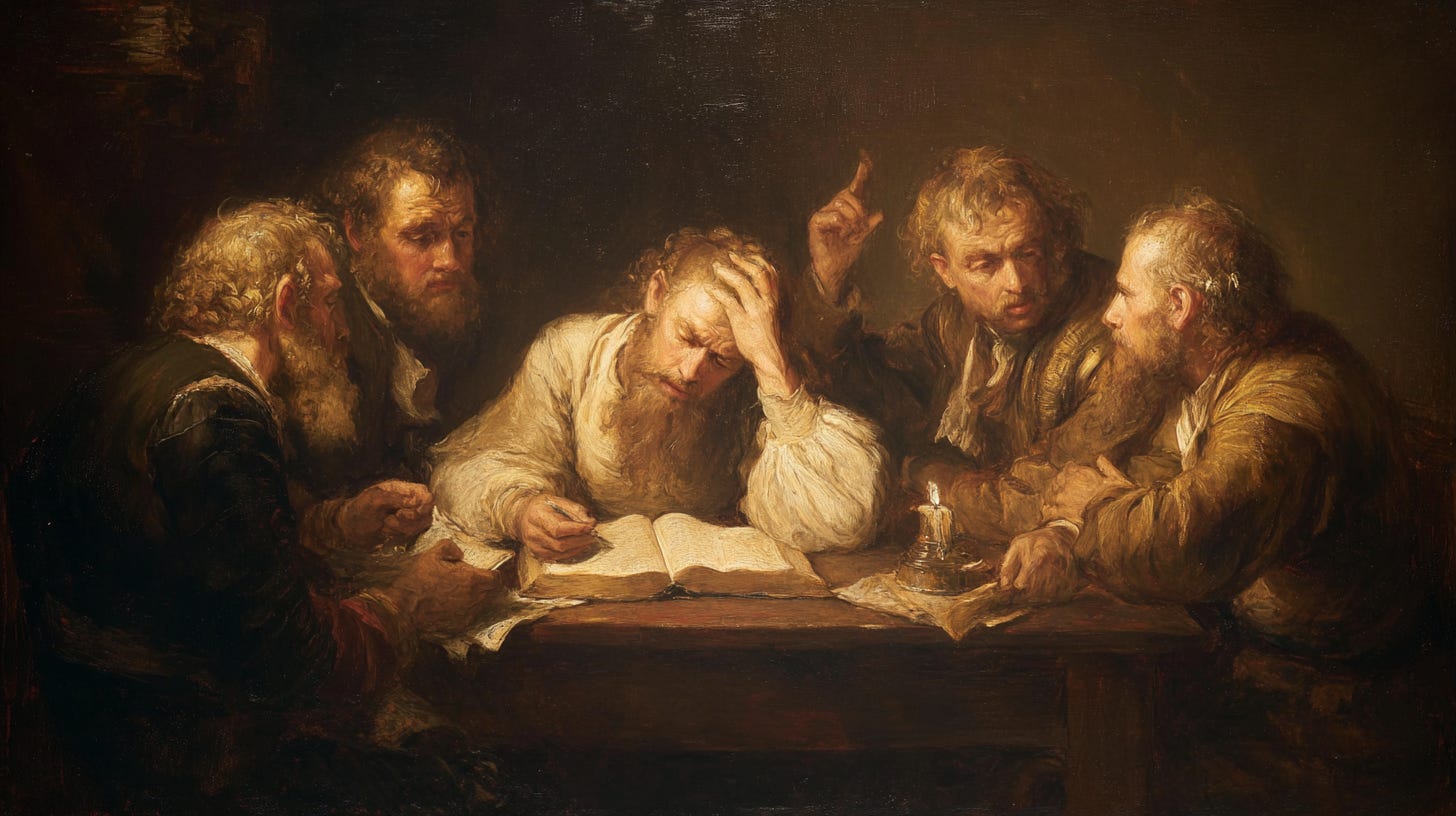
A group of elders gathered around the table — everything on the agenda except themselves.
Somewhere in the back of my mind, after years of serving on elder boards, a quiet observation began to take shape. I’ve sat through hundreds of elder board meetings — budget reviews, staff evaluations, ministry assessments, facility decisions. We were thorough. We were diligent. We took our responsibilities seriously.
We evaluated the youth program. We assessed the worship team. We reviewed the pastor’s effectiveness. We analyzed attendance trends and financial projections.
Those pastor reviews were cursory at best. Once, when I raised the idea of a more formal evaluation process, the pastor visibly tensed. Then he stood up mid-conversation and excused himself. I looked around at the other elders’ faces, and without another word I suggested we table it for another time. We never came back to it. What I didn’t know then — what I’ve since come to understand — is that the resistance itself was a signal. And signals ignored have consequences.
What we rarely did — what most elder boards rarely do — is sit down together and ask the hard questions about our own health as a board.
Are we functioning the way Scripture calls us to? Are we truly shepherding this congregation, or are we managing it? Are there dynamics among us that are quietly undermining everything we’re trying to build?
The irony is sharp. The men entrusted with overseeing the health of a local church are often the least examined people in the room.
We Are Good at Evaluating Everything Else
The pattern isn’t difficult to explain. Evaluating programs, budgets, and staff feels productive. There are metrics. There are outcomes. There’s a clear path from problem to solution. You identify a weakness in the children’s ministry, you address it. You see a budget shortfall, you make adjustments. The process is uncomfortable at times, but it’s familiar.
Self-examination is different. It’s personal. It surfaces things that can’t be resolved with a budget adjustment or a staffing change. It requires a kind of vulnerability that doesn’t come naturally in a room full of respected men who carry real authority in a congregation.
And so we avoid it — not out of bad intentions, but out of self-protection. Out of the subtle, mostly unconscious belief that we are the ones doing the examining, not the ones being examined.
The Proverbs writer understood this dynamic long before elder boards existed:
“Iron sharpens iron, and one man sharpens another.” (Proverbs 27:17, ESV)
That sharpening is not painless. Iron on iron produces friction. Sparks. Heat. And something genuinely useful only comes from that friction — not from iron laid gently beside iron with no contact at all.
Most elder boards are iron laid gently beside iron. We are present with each other. We pray together. We even care for one another in genuine ways. But we have largely agreed, without ever saying so, not to press too hard against each other.
The Invitation of Psalm 139
The great irony of board self-examination is that it is not a modern management concept. It is a deeply biblical practice.
David’s prayer in Psalm 139 is one of the most intimate passages in all of Scripture — a soul laid bare before God, inviting a thoroughness of examination that most of us avoid in every other area of life.
“Search me, O God, and know my heart! Try me and know my thoughts! And see if there be any grievous way in me, and lead me in the way everlasting.” (Psalm 139:23–24, ESV)
Notice what David is asking for. Not comfort. Not affirmation. Not a review of his accomplishments. He is asking to be searched. To be tried. To have his hidden ways brought to light.
This is the posture that biblical eldership requires — not from the congregation alone, not from the pastoral staff alone, but from the elders themselves.
When was the last time your elder board prayed Psalm 139:23–24 together — and meant it?
When was the last time you collectively invited The Shepherd to search your board’s health, your relational dynamics, your patterns of decision-making, your capacity for honest accountability with one another?
If that question makes you uncomfortable, you are in good company. It makes me uncomfortable too. But discomfort in the right direction is often the beginning of something important.
What Boards Don’t Ask
In my years of board service, I came to recognize the questions that healthy boards should be asking but rarely do. Questions like:
Do we have genuine trust among us, or do we maintain a polished surface while walking on eggshells?
Are there relational dynamics — old conflicts, unspoken tensions, unresolved grievances — that quietly shape how we make decisions?
Is every elder’s voice genuinely valued, or have we quietly arranged ourselves around one or two dominant personalities?
Does our pastor feel shepherded by us, or has he learned that certain topics are off the table?
Are we evaluating programs to avoid evaluating ourselves?
These are not trick questions. They are the questions that spiritually healthy, relationally mature elder boards wrestle with honestly. The avoidance of them is not a sign of peace — it is a sign that something important is being left unexamined.
The congregation cannot be healthier than the board that shepherds it. That is not a platitude. It is a principle I have watched play out over decades, in church after church, in patterns of leadership that looked strong on the surface until the weight of the unexamined broke something that couldn’t easily be repaired.
A Word to the Elder Who Feels This
If you are reading this as an elder or deacon, and something in these words is stirring something in you, I want to speak directly to you for a moment.
You are not alone. The board dynamics I’m describing are not unique to your church. They are close to universal. And recognizing them — even privately, even before anyone else does — is not a betrayal of your fellow elders. It may be the beginning of something that serves them.
The question is not whether your board has blind spots. Every board does. The question is whether you are willing to name that reality, to invite the kind of honest examination that The Shepherd calls all of his under-shepherds to, and to seek something better.
That willingness is rare. And it is holy.
Looking Ahead
In the coming weeks, I want to explore what intentional elder board health assessment actually looks like — what it means to build a structure for the kind of self-examination David was modeling in Psalm 139, one that is specific, honest, and genuinely useful for boards that want more than good intentions.
For now, I leave you with the prayer. Not as a formula — as an invitation.
Search me, O God, and know my heart. Try me and know my thoughts. See if there be any grievous way in me, and lead me in the way everlasting.
If you are an elder or deacon, that prayer was never only for individuals. It belongs to every board gathered in The Shepherd’s name.
Wounded Shepherd exists to help local churches build the kind of leadership that honors Christ and demonstrates His character to a watching world. If this resonates with you, subscribe to receive future articles.