
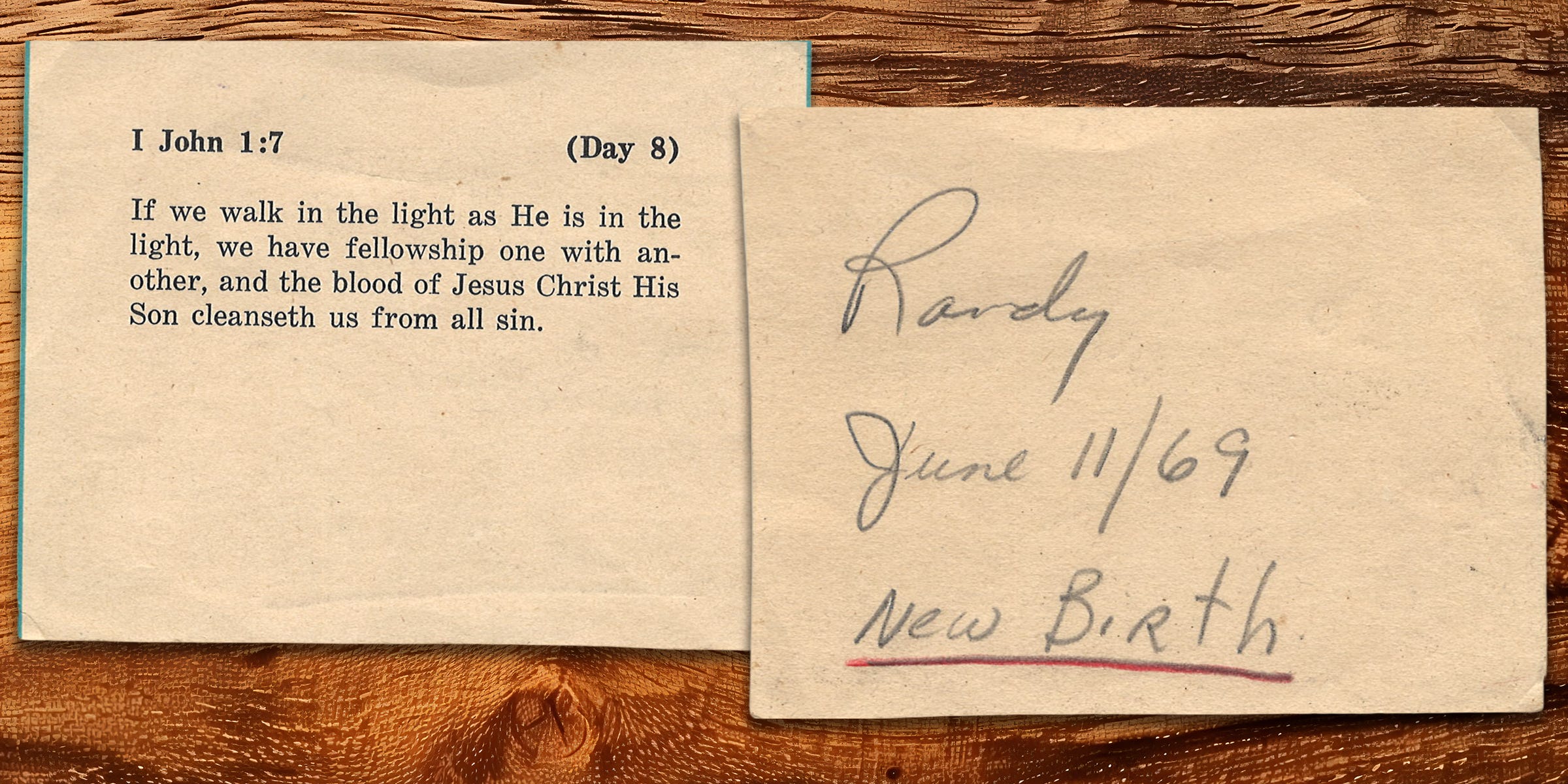
It was handed out on Day 8 of Vacation Bible School at Tulsa Bible Church in the summer of 1969. The memory verse on one side is 1 John 1:7. The other side has my name written in cursive — not mine, a volunteer’s — the date June 11, and the words “New Birth,” underlined in red.
I raised my hand at the altar call. I recited the sinner’s prayer with the rest of the children, in the prescribed words, and meant it as much as a ten-year-old can mean anything. And for years afterward I would have told you, with complete sincerity, that I knew Jesus.
What I had was a folder full of right answers.
We interrogate Scripture when Scripture should be interrogating us. That sentence has been sitting with me for months, and I keep coming back to it because it names something I lived for a long time before I had words for it. I came to Scripture as a quiz I had already passed. I knew the answer to most of the questions before I read the page. The Jesus I had been given was correct in His outlines. He had died for my sins. He was the Son of God. He had risen on the third day. I could recite all of it. I could defend most of it. I could even teach some of it.
But I did not know Him.
Many of us were given a Jesus we believed in before we were given a Jesus we knew. And the work of the Christian life, as I have come to understand it, is the long process of letting Scripture move what we know about Him into who He is to us.
Paul writes to the Colossians something that should stop us every time we read it.
“He is the image of the invisible God, the firstborn of all creation. For by him all things were created, in heaven and on earth, visible and invisible, whether thrones or dominions or rulers or authorities—all things were created through him and for him. And he is before all things, and in him all things hold together. And he is the head of the body, the church. He is the beginning, the firstborn from the dead, that in everything he might be preeminent. For in him all the fullness of God was pleased to dwell, and through him to reconcile to himself all things, whether on earth or in heaven, making peace by the blood of his cross.” (Colossians 1:15-20)
Read that slowly. The Christ Paul is describing is the One through whom all things were created and in whom all things hold together. The fullness of God was pleased to dwell in Him. He is preeminent in everything.
This is not the Jesus of the flannel board. The flannel board Jesus was kind to children and walked on water and told stories. He was not wrong, exactly. He was just small. The Jesus I was given as a boy was a Jesus my ten-year-old mind could hold. The Jesus of Colossians 1 cannot be held by anyone’s mind, and certainly not by the version of mine that was raising its hand on Day 8 of VBS.
This is part of why Scripture has to keep working on us. Every season of life puts us in front of a Christ we did not have categories for the season before. The Jesus you knew at twenty is too small for what you face at forty. The Jesus you knew at forty is too small for what you face at sixty. Not because He has changed, but because Scripture’s Christ has more in Him than we have yet seen, and we only see what we have been with long enough to recognize.
I drifted.
A year after the kraft paper, my family moved to Chillicothe, Missouri, and we started attending First Baptist Church there. I was baptized in the big sanctuary. On Sunday mornings the youth group sang praise songs out of a paperback songbook — songs from what I now recognize as the Jesus Movement, songs that had been written that year or the year before, songs that someone had decided we should learn. I sang them. I knew the words. Whether anything was happening underneath the words I could not have told you at the time. But something was being put into me that did not seem important until much later, when it turned out to have been there all along.
After we moved to Dallas when I was around fourteen, I left church behind in the way teenagers do, which is to say I left it behind without ever announcing it. By college I was not following Jesus by any honest measure. I had the kraft paper somewhere in a drawer, but the words underlined in red did not seem to be doing anything in my life.
It would take marriage, and then children, and then the slow pull of something I could not name, before I started to come back. A short term mission trip to Juárez was part of that turn — though by then the turn had been happening for a while underneath. I do not point to a single moment. I point to a long pattern of Him pursuing me while I assumed I had Him already because I had once raised my hand.
I tell you this not because my story is unusual. I tell you this because I suspect it is not unusual at all.
Many of us were handed a true Jesus, in true words, in churches that meant well, by people who loved us. And many of us discovered, sometimes decades later, that being handed Him is not the same as knowing Him. The handing was a gift. It was not the destination.
Every culture and every era shapes its picture of Christ in ways that need examining. That work matters, and others have done it well. But for most of us, the more immediate gap is not between the cultural Jesus and the historical Jesus. It is between the Jesus we have correct information about and the Jesus whose voice we would recognize in a crowded room.
In John 14, Philip says something that I have come to read as the most painfully honest sentence in the Gospel. “Lord, show us the Father, and it is enough for us.” Show us. We have followed You. We have heard You teach. We have seen the miracles. But show us the Father.
Jesus answers him with what may be the most quietly devastating sentence in Scripture. “Have I been with you so long, and you still do not know me, Philip?”
So long. With you.
The disciples had spent three years walking with Him. They had eaten with Him, slept near Him, watched Him weep and watched Him pray. And He still had to ask Philip whether being with Him that long had produced the knowing that being with Him was supposed to produce.
If Philip could spend three years with the incarnate Son of God and still not know Him, then the question for us is not whether we have the right information. It is whether we have been with Him long enough to recognize Him. Whether the time we have spent in Scripture is the time of a student preparing for an exam, or the time of a child sitting with a parent, learning a face.
Here is what I think this means, practically.
The remedy for a Jesus we know about but do not know is not better information. It is presence. It is reading Scripture as the voice of someone who is trying to find us, not as a quiz we have already passed. It is prayer that is not a transaction. It is silence long enough for the recognition that comes only from time spent.
It is letting Colossians 1 make us small. Letting John 14 ask us Philip’s question. Letting the Christ of Scripture be larger than the Christ we were given, not because we are abandoning what we were given but because we are letting it grow up.
The kraft paper is still in a drawer at my house. Day 8. June 11, 1969. New Birth, underlined in red. I do not regret it. The handing was a gift, and I needed it, and I would not have what I have now without it.
But the Jesus underlined in red on a piece of kraft paper was the beginning. He was never meant to be the end. And the long, slow, patient work of the Christian life is letting the Christ of Scripture become the Christ we know — not because the Jesus we were given was wrong, but because He was always so much more than what fit on the page.
Have you been with Him long enough to know Him?
That is the question Scripture keeps putting in front of me. I am still answering it.