
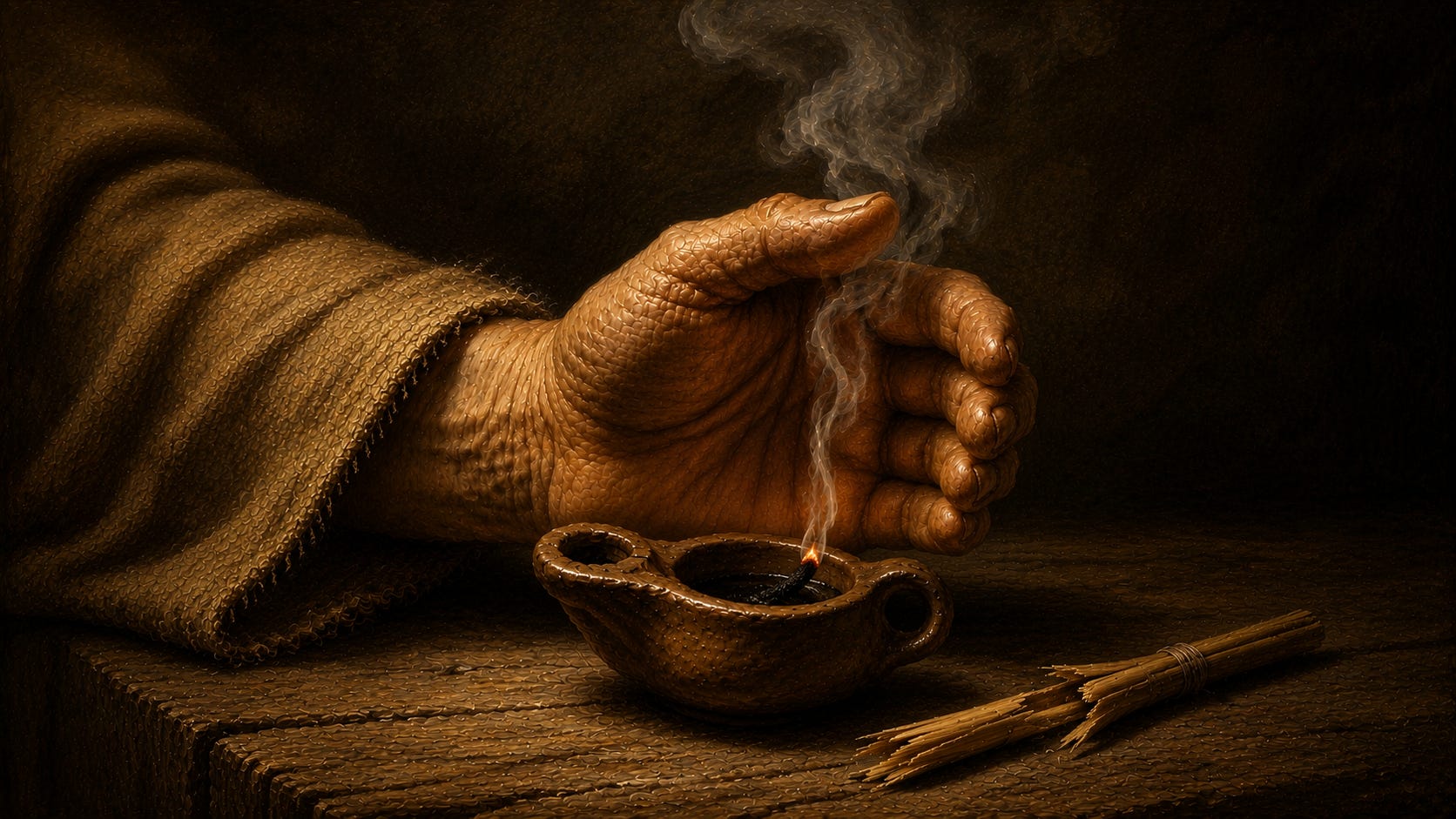
Matthew tells us that when Jesus knew the religious leaders were plotting against Him, He withdrew. The crowds followed Him, and He healed them, and He told them not to make Him known. Then Matthew does something he does often. He reaches back into the prophets to tell us what kind of person we are watching. He reaches back to Isaiah. And of all the things he could have quoted to describe the Son of God at the height of His public ministry, he chose this:
“a bruised reed he will not break, and a smoldering wick he will not quench, until he brings justice to victory” (Matthew 12:20 ESV).
That is the verse I want to sit with. Not because it is famous. Most of the people I have known in wounded churches have never had it read over them, and that absence is part of the wound. I want to sit with it because it tells the truth about who The Shepherd is toward exactly the people a church is most likely to discard.
A bruised reed is a piece of marsh grass that has been stepped on or bent until it cracks. A reed is already the most fragile thing in the field. A bruised one is worthless. You cannot lean on it. You cannot make music with it. The reasonable thing, the efficient thing, is to snap it the rest of the way and throw it down. No one keeps a cracked reed.
A smoldering wick is a lamp that has nearly gone out. There is no flame left, only a thread of smoke and the smell of something dying. It gives no light. It is doing nothing but fouling the air. The reasonable thing, the efficient thing, is to pinch it out and be done with it. No one tends a wick that has stopped burning.
That is the point of the two pictures. Isaiah chose, and Matthew chose after him, the two things any sensible person throws away. The bent reed and the dying flame. And they tell us that the Servant of God, the One Matthew says is Jesus, does neither. He does not snap the reed. He does not pinch out the wick. He bends down to the very things the rest of us write off, and He tends them.
I think you may know what it is to be treated like a bruised reed.
Maybe you came into a church already cracked, carrying something heavy, and instead of being tended you were managed. Maybe you served faithfully for years and then, the moment you became inconvenient, you discovered how quickly you could be set down. Maybe you asked a hard question, or named something that was wrong, and the people who should have listened decided it was easier to break you than to hear you. Maybe you simply broke, the ordinary way that people break, and found that the room had no patience for it.
And here is the part that does the deepest damage. It was often done in His name. The hand that pressed on the bruise was a hand that prayed. The voice that told you, in words or in silence, that you were too much, too broken, too far gone to keep, was a voice that preached on Sundays. That is the particular cruelty of being wounded inside a church. The wound comes wearing the costume of the Shepherd. And so it becomes very easy to believe that The Shepherd Himself agrees with the people who discarded you.
He does not. That is the whole reason I am writing this.
I am not writing to you from above this. I have stood where you are standing.
I have been the reed that someone decided was not worth keeping. I have sat in a parking lot after a meeting and wondered whether the God those men claimed to speak for had quietly agreed with their assessment of me. I know what it is to keep showing up with a flame so low it is mostly smoke, and to feel the people around you watching it, waiting for it to go out so they can stop pretending it is still a fire.
I will tell you something harder, because this is not only a letter to the wounded. I have also been on the other side of it. There were seasons when I sat in the leader’s chair and looked at someone who was barely holding on and felt, somewhere underneath my theology, that it would be cleaner if they would simply go. I did not always reach for the bruised reed. Sometimes I was relieved when it broke on its own and I did not have to decide what to do with it. I have repented of that, and I am still repenting of it. So when I tell you that The Shepherd is not like the people who discarded you, I say it as a man who has needed Him to be unlike me.
So look again at what Matthew says, because it is more than gentleness.
The verse does not end with the reed and the wick. It ends with justice. “a bruised reed he will not break, and a smoldering wick he will not quench, until he brings justice to victory” (Matthew 12:20 ESV). The same Servant who refuses to break the bruised is the One who carries justice all the way to victory. His tenderness is not weakness. It is not Him looking away from what was done to you because He is too soft to deal with it. The One who is gentle with you is the same One who will set right everything that bent you in the first place. The reed He protects and the justice He brings are the same work, done by the same hands.
That matters for the wounded more than almost anything. Because the lie that travels with the wound is that tenderness and justice are opposites. That to be cared for gently you must let the wrong go, and that to see the wrong named you must harden into someone you do not want to become. The Servant holds both. He will not break you. And He will not let what broke you stand forever. You do not have to choose between being tended and being vindicated. He does both, and He does them with the same hands.
I want to be careful here, because the wrong ending to this would be to send you back to the same hands that pressed on the bruise and tell you to try harder to be tended by them. That is not what I am saying. Sometimes the most faithful thing a bruised reed can do is get out of the grip that was breaking it.
What I am saying is that there is a Shepherd who is not those hands. There is One who looked at a hillside full of cracked reeds and smoking wicks, all the people the religious establishment of His day had given up on, and instead of clearing them away He healed them, and warned them not to make a spectacle of it, and let the prophet’s old words settle over the scene. He will not break you. The flame you think is almost gone is a flame He has chosen, so far, not to put out. That is not an accident. He is tending it.
You are not too broken to be kept. You were told that by people who were not qualified to say it. The only One qualified to make that judgment has already made the opposite one, and He made it among a crowd full of the same kind of broken people you are afraid you have become.
So bring Him the bruise. Not the performance of being fine. The actual bruise. He has never once, in all of Scripture or all of history, snapped off the reed that was handed to Him in honesty.
He will not start with you.