
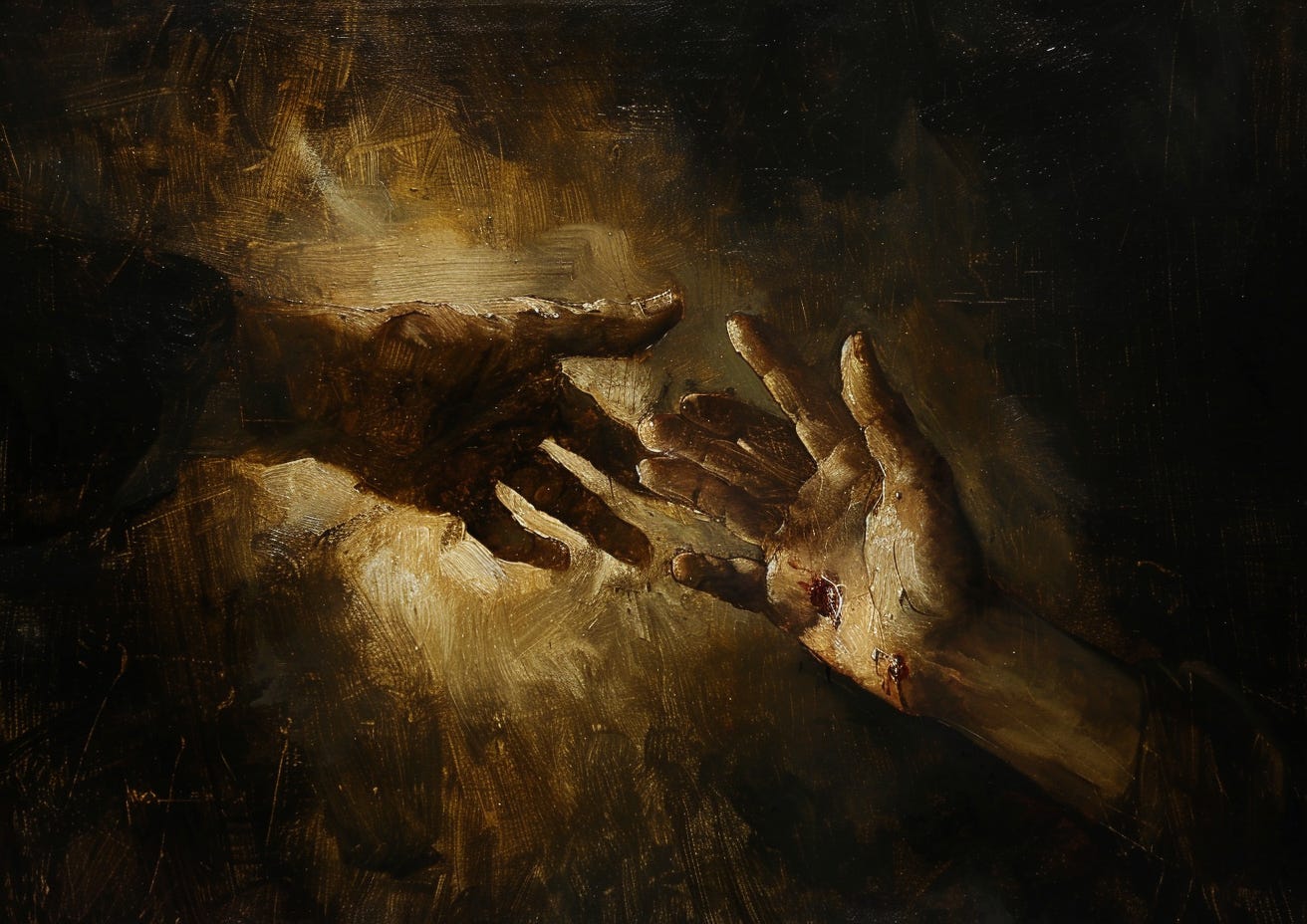
We gave him a nickname, and it has stuck for two thousand years. Doubting Thomas. Say the first half in any Sunday school room and the class will finish it for you. One sentence, spoken in the worst week of his life, and we have treated him as the patron of weak faith ever since.
I want to read his story again, slowly. Because somewhere in twenty centuries of sermons, we lost track of what actually happens in that room. And I have watched wounded believers apologize for their own caution too many times—as if needing to be sure were a defect, as if the guarded heart were the same thing as the hard one. Thomas’s story says otherwise. Read carefully, it may be the kindest passage in the Gospels for anyone who has to see before they can trust again.
He Was Not There
John tells it plainly: “Now Thomas, one of the Twelve, called the Twin, was not with them when Jesus came” (John 20:24 ESV).
We are not told where he was. But we know what that week had done to all of them. The Shepherd they had left everything to follow was arrested by the religious authorities, condemned in a rigged proceeding, and executed while most of them hid. Grief scatters people. Some huddle together behind locked doors; some need to carry the loss alone for a while. Thomas was the second kind, and Scripture spends not one word rebuking him for it.
When he came back, the others met him with the best news anyone has ever delivered: “We have seen the Lord” (John 20:25 ESV).
And Thomas could not receive it. “Unless I see in his hands the mark of the nails, and place my finger into the mark of the nails, and place my hand into his side, I will never believe” (John 20:25 ESV).
There is the sentence that earned the nickname. But before we join the centuries of head-shaking, look one scene earlier at what had already happened in that room.
He Asked for Nothing They Had Not Been Given
On the evening of the resurrection, Jesus had come and stood among the other disciples, behind their own locked doors. And notice what He did before anything else: “he showed them his hands and his side. Then the disciples were glad when they saw the Lord” (John 20:20 ESV).
They saw first. Then they were glad. The ten did not believe a secondhand report; they believed a risen Christ standing in front of them with the evidence still in His body. Their faith was born exactly the way Thomas asked for his to be born—by sight, by wounds, by proof.
So be precise about what Thomas actually requested. Not a sign no one else had received. Not a private miracle. He asked for what his brothers had already been given, nothing more. Thomas asked for nothing the other disciples had not already been given. They believed when they saw. He only asked to see.
That distinction matters, because it is the same distinction the church keeps failing to make with its wounded. The person who says, “I trusted a report once, and it nearly destroyed me; this time I need to see,” is not doing something different from what the ten did. They are only asking to touch what everyone around them insists is true.
Eight Days in the Room
Now watch the quietest verse in the story do its work: “Eight days later, his disciples were inside again, and Thomas was with them” (John 20:26 ESV).
Thomas was with them. He did not believe their report—he had said so in the strongest terms a man can use—and he was still there. Whatever was unsettled in him, he stayed near the people who claimed to have seen the Lord. You can be in the room before you believe the room. Thomas was.
And the other side of that verse is just as remarkable. They kept him. Ten men glowing with resurrection joy shared eight days with a brother who thought their testimony was impossible, and there is no hint that anyone issued an ultimatum. No one made belief the price of belonging. The first fellowship the risen Christ ever had on this earth held a man who did not yet believe in the risen Christ, and held him gently.
Both graces are worth naming, because both are in short supply. The wounded need permission to stay near while trust is still forming. And churches need the patience to keep the guarded close without demanding they perform a confidence they do not have. The room that shames its slow ones empties itself of exactly the people Christ came back for.
He Kept His Scars
Then Jesus came. “Although the doors were locked, Jesus came and stood among them and said, ‘Peace be with you’” (John 20:26 ESV). And His next words went straight to the one man in the room still carrying his conditions: “Put your finger here, and see my hands; and put out your hand, and place it in my side. Do not disbelieve, but believe” (John 20:27 ESV).
Hear the tone of it. There is no lecture in front of the others. There is no wounded pride, no how-dare-you-demand-proof-of-Me. Jesus repeats Thomas’s own conditions back to him, almost word for word, and then meets every one of them. The finger. The hands. The side. Whatever Thomas needed to see, Christ had already decided to show him before Thomas ever asked. “Do not disbelieve, but believe” is not a scolding; it is an invitation issued with the evidence already extended.
And here is the detail I cannot get past: the risen Christ has scars.
Think about what that means. Resurrection is God’s power to make all things new, and the body Jesus rose in could have been unmarked—every trace of the crucifixion erased, the whole horror smoothed over as though it had never happened. Instead, He kept the wounds. The one glorified body in existence carries nail marks and a spear wound, and the first use He put them to was answering a doubter’s need for proof. The evidence the guarded heart required was something He chose to carry in His own flesh.
Christ does not shame the need for proof. He kept His scars to answer it.
What This Asks of Us
If you are the wounded one—the one who has been told your caution is a sin, that real faith would simply trust again, that your questions are the problem—look hard at this story. The risen Lord met a man’s conditions without a word of shame. Your “unless I see” does not disqualify you from Him. Bring it to Him honestly, the way Thomas did, and let Him decide how to answer it. He has never been threatened by a guarded heart. And hear the permission underneath: needing to see is not the same as refusing to believe. Thomas’s demand was grief talking, and Jesus knew the difference. He still does.
A necessary word of care here, because trust has more than one object. Thomas was being asked to trust the true flock—brothers with the risen Christ standing among them—and even then, Christ Himself supplied the proof. You may be facing a very different room. If the church that wounded you is still what it was, still led by men who have never repented of the harm, then your refusal to hand them your trust is not doubt. It is discernment, and it is permitted. The trust this story rebuilds runs first to Christ Himself, and then, held by Him, toward a flock that can actually bear inspection. Some rooms cannot. You are not obligated to prove your faith by re-entering one. The road He walks with you leads toward a sanctuary, not back into a den.
If you serve as an elder or shepherd a church, this story sets your standard in two ways. First, be a fellowship that can keep a Thomas—a room where the guarded and the unconvinced can stay near for their eight days, or their eight months, without belief being made the price of belonging. Second, be leaders who can bear inspection. A shepherd who resents “show me” is telling you something. The Chief Shepherd opened His hands and His side to a doubter’s examination; an undershepherd with nothing to hide can survive a season of watchfulness from sheep who have been bitten before. Trust that cannot be examined was never trust. It was only compliance.
The Highest Confession in the Room
Then comes the ending we forget. Thomas—the doubter, the demander of proof, the nickname—answers Him: “My Lord and my God!” (John 20:28 ESV).
Read John’s Gospel end to end and you will not find a fuller declaration of who Jesus is in the mouth of any disciple. It comes from the most guarded man in the room. The slow trust, once it arrived, went deeper than anyone’s. That is worth remembering about the careful ones. Trust rebuilt from evidence, from patience, from scars examined up close, tends to hold.
Jesus’s last word in the scene reaches past Thomas, to us: “Have you believed because you have seen me? Blessed are those who have not seen and yet have believed” (John 20:29 ESV). Some read that as a final slap at Thomas. It is not. It is a blessing spoken forward, over every believer who would come after the eyewitnesses—John says so himself a breath later: “these are written so that you may believe that Jesus is the Christ, the Son of God” (John 20:31 ESV). The whole scene was preserved for the ones who would need it.
Maybe that includes you. The Shepherd who meets you on the far side of your worst week is not an unmarked Christ. He carries the evidence of what it cost to bring you home, and He has never been ashamed of a sheep that needed to see it. One guarded man. Eight patient days. Two open hands.
The nickname was never the point of the story. The scars were.