
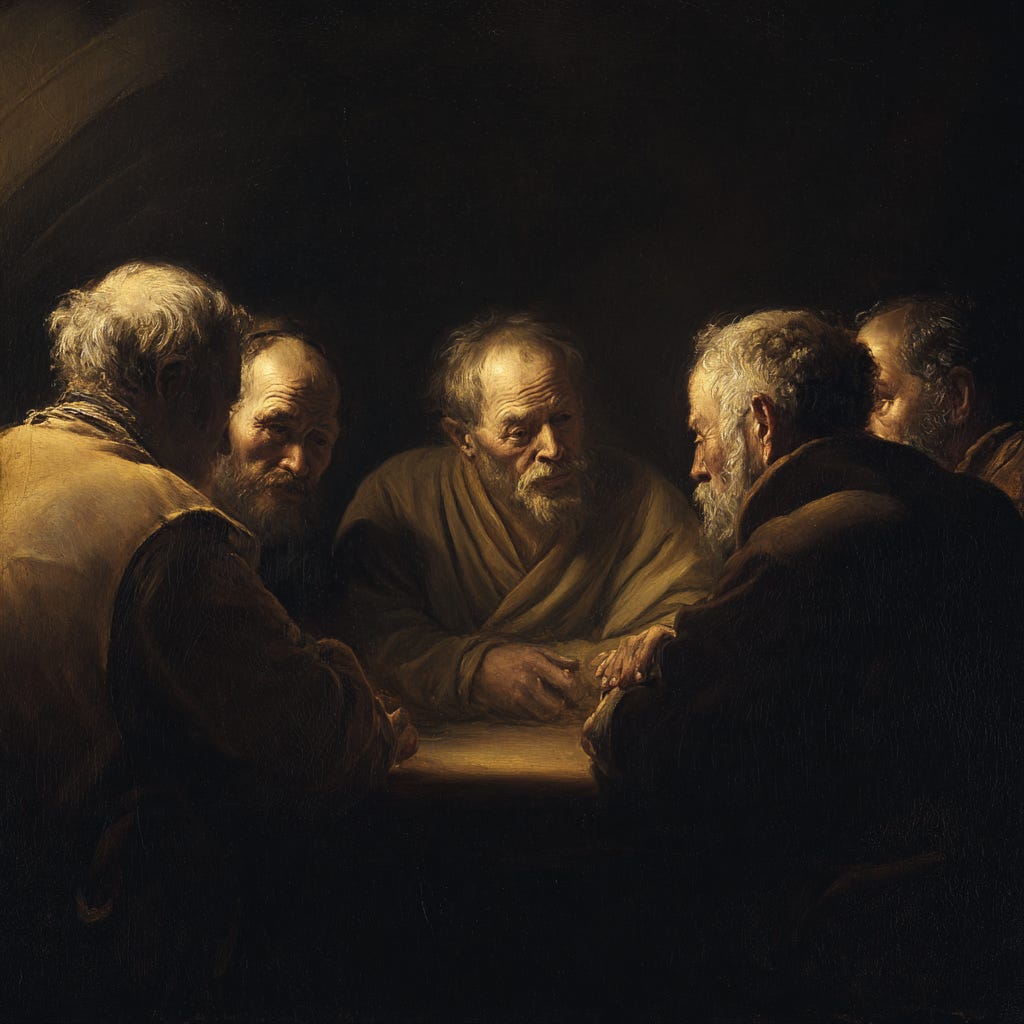
Most of us have never seen a healthy elder board up close.
That sentence is not an indictment. It is a starting point. You can spend decades in the pews of faithful, loving, Christ-honoring churches and still never get a clear look at the room where the decisions are made. The board is usually somewhere down a hallway. The minutes are usually not published. The dynamics are usually not discussed.
So when something goes wrong - when a leader drifts, when a pastor is protected at the expense of the flock, when an elder is pushed out for asking the wrong question - most of us don’t have a reference point. We don’t know what the room was supposed to look like in the first place. We can feel that something is off. We just can’t always name what.
I’ve sat in that room. For more than twenty years I served as a lay elder in evangelical churches. At one point I chaired the board. I have seen healthy board dynamics and I have seen deeply dysfunctional ones, and I can tell you from the inside that the difference is not hidden. It has a shape. Scripture describes the shape. Most churches have just never seen it rendered clearly enough to recognize.
So let’s try to render it.
This is not a checklist. Biblical eldership does not reduce to a scorecard, and no board earns its health by ticking boxes. It is a description - a portrait of what faithful plural leadership actually looks like when it is functioning as Christ intended. Hold it loosely enough to let the Spirit apply it. Hold it firmly enough to tell the truth about what you see.
But before we describe the shape of the room, we have to name the One who stands above it.
Before the shape: the One above the shape
Everything that follows rests on a prior claim, and the prior claim is the one most boards lose sight of first.
Elders are not finally accountable to one another. They are accountable, together, to Christ.
A healthy elder board is a council of equals. No elder lords it over another. No chairman lords it over the council. No pastor lords it over the elders. But a council of equals, by itself, is not enough. A council of equals can still drift together. A council of equals can still close ranks. A council of equals can still protect what it should expose, if it has lost sight of the One above it.
The biblical elder answers to the Chief Shepherd before he answers to anyone else in the room. 1 Peter 5:4 names him by that title: “And when the chief Shepherd appears, you will receive the unfading crown of glory.” Peter is writing to fellow elders. He is telling them that their shepherding is not autonomous. It is delegated. The sheep belong to Christ. The office belongs to Christ. The accounting, when it comes, will be rendered to Christ.
That one sentence reorders everything.
It means the pastor is not the final authority in the room. It means the chairman is not the final authority in the room. It means the longest-tenured elder is not the final authority in the room. It means the board itself is not the final authority in the room. Christ is. And because Christ is, every elder in the room has both a higher loyalty and a greater freedom than institutional pressure alone can ever grant him.
This is the distinction most boards get wrong, and it is the reason most boards get derailed.
When a board forgets that it answers to Christ, it eventually starts answering to something smaller - the pastor’s preference, the institution’s image, the loudest donor, the path of least congregational conflict, its own cohesion. None of these are neutral masters. All of them, given enough time, will pull a board away from the flock and away from Scripture. A board that has forgotten the Chief Shepherd will not notice the drift. It will feel, from the inside, like peace. It will feel like unity. It will feel like wisdom.
It is none of those things. It is disorientation.
The horizontal accountability we are about to describe - elders to one another, board to congregation, all of it - only works when the vertical accountability is clear first. Take the Chief Shepherd out of view, and the rest of this portrait collapses. Keep him in view, and the rest of the portrait becomes possible.
But there is one more foundation to name before we describe the room.
Before the shape: the kind of men who stand in it
A board is only as healthy as the men who sit on it. Structure cannot save a board from the character of its elders. Governance cannot substitute for godliness. No process, no bylaw, no accountability mechanism can hold a board together if the men in it are not, themselves, the kind of men Scripture describes.
This is why the biblical case for eldership does not begin with duties. It begins with character.
1 Timothy 3:2-7 gives the list: “Therefore an overseer must be above reproach, the husband of one wife, sober-minded, self-controlled, respectable, hospitable, able to teach, not a drunkard, not violent but gentle, not quarrelsome, not a lover of money. He must manage his own household well, with all dignity keeping his children submissive, for if someone does not know how to manage his own household, how will he care for God’s church?” Paul gives one teaching qualification. He gives roughly a dozen character ones. Titus 1:5-9 repeats the pattern.
Read the lists carefully. They are almost entirely about who a man is, not what he can do. Above reproach. Sober-minded. Self-controlled. Gentle. Not quarrelsome. Not a lover of money. A man whose household reflects the same character he will bring to the church.
Most boards that drift do so not because they lack structure. They drift because somewhere along the way, character stopped being the primary qualification for who sat in the room.
Competence crept in. Charisma crept in. Generosity to the church crept in. Length of attendance crept in. Business success crept in. Willingness to serve crept in. None of those are disqualifying - some of them are genuinely helpful. But none of them are the biblical starting point. When they become the starting point, the character list gets soft-pedaled. The hard question - is this man the kind of man Paul describes, or is he something else we have found useful? - stops being asked.
Character matters because character is what Scripture requires. Not because it makes a board look better. Not because it prevents scandal - though it does. Not because it reassures the congregation - though it should. Character matters because the Chief Shepherd set the standard, and the standard is not negotiable.
A board of godly men with imperfect processes will stumble toward health over time. A board of ungodly men with perfect processes will protect their dysfunction with precision. The difference is not the structure. The difference is the character of the men in the room.
So before the shape of the board, ask about the character of the elders. Both matter. But one comes first.
1. Elders are accountable to one another. Not just to the pastor. Not just to themselves.
With the Chief Shepherd above the room and the right kind of men inside it, we can describe the first of the five characteristics that mark a healthy board.
Because elders answer to Christ, they can - and must - answer to one another.
In a healthy elder board, every elder is accountable to every other elder. The pastor, if he serves as a teaching elder, is not above this accountability - he is inside it. His character can be questioned. His decisions can be challenged. His blind spots can be named. And he does not retaliate when they are, because he has already agreed - in writing or in practice - that this is the cost and the blessing of plural leadership.
1 Timothy 5:19-20 sets the standard: “Do not admit a charge against an elder except on the evidence of two or three witnesses. As for those who persist in sin, rebuke them in the presence of all, so that the rest may stand in fear.” Paul assumes, without apology, that an elder could sin - and that when he does, his fellow elders are the ones who confront it. Publicly. The point of the “two or three witnesses” clause is protection against frivolous accusation, not insulation from accountability.
A board that cannot rebuke its own is not a board. It is a fraternity.
Dysfunction looks like this: one personality carries more weight than all the others combined. Disagreement is framed as disloyalty. Confrontation is framed as divisiveness. The loudest voice in the room is never interrupted, and the quietest voice in the room eventually stops speaking.
Health looks different. In a healthy board, the pastor can be told he is wrong without losing his standing. The chairman can be corrected by the newest elder without losing his dignity. Disagreement is not softened into oblivion by the need to keep the peace. Peace is not the absence of hard conversation. It is the fruit of faithfulness.
2. The elders serve the flock, not the institution.
There is a test that sorts boards quickly. Ask it privately, in your own heart, next time you sit in a meeting.
When a decision has to be made, whose interests are protected first - the church’s reputation, or the sheep’s wellbeing?
A healthy board answers that question the same way Christ does. The sheep. Every time. Acts 20:28 puts the matter plainly: “Pay careful attention to yourselves and to all the flock, in which the Holy Spirit has made you overseers, to care for the church of God, which he obtained with his own blood.” The flock was purchased with blood. The institution was not.
The elders do not own the flock. They oversee a flock that belongs to someone else. And the One it belongs to paid the purchase price himself. A board that remembers whose flock it is finds it harder to rationalize protecting the brand at the sheep’s expense. A board that has forgotten will find a reason every time.
Healthy elders know they are stewards of people, not custodians of a brand. When the two come into conflict - and eventually they always come into conflict - the healthy board is willing to lose the brand to protect the people.
Dysfunction inverts the order. The reputation is protected. The giver is protected. The program is protected. The staff member who can’t be spared is protected. And the sheep - the quiet ones, the wounded ones, the ones without influence - are asked to absorb the cost. Again.
Over time, a board that protects the institution over the flock stops being able to see the flock at all. Faces blur into attendance numbers. Concerns blur into complaints. And the people Christ purchased with his own blood become a management problem.
3. Governance is transparent to the congregation.
A healthy elder board does not fear the light. It operates in it.
That does not mean every decision is subject to a congregational vote. It does not mean every disagreement is aired from the stage. Plural leadership is given the authority to lead - and some decisions are appropriately made in the room, communicated from the room, and not debated from the pew. But the posture is one of openness, not opacity. The congregation knows who the elders are. The congregation knows how the elders are chosen. The congregation knows what the elders actually do, in broad terms, and has access to those who hold the office.
Dysfunction hides. Decisions are made without traceable process. Key information is withheld until after the decision is final. Questions from members are treated as attacks. The phrase “that’s a board matter” becomes the answer to questions the board does not want to answer.
A healthy board understands that the congregation is not the enemy. The congregation is the flock the elders were called to shepherd. Withholding information from them, as a default, is not wise leadership. It is a failure of trust that eventually teaches the flock not to trust back.
4. Authority is held with a servant’s posture.
Acts 6:1-7 is easily misread. When the Hellenist widows were being overlooked, the apostles did not assert their rank. They did not pull rank on the complaint. They recognized a legitimate need, identified the gap in their own capacity, and commissioned others to meet it - men full of the Spirit and of wisdom. The posture is striking. Authority, bent toward the need. Leadership, looking down the table at those being overlooked, not up the ladder at those being impressed.
Peter writes the same thing from a different angle in 1 Peter 5:2-3, addressing his fellow elders: “Shepherd the flock of God that is among you, exercising oversight, not under compulsion, but willingly, as God would have you; not for shameful gain, but eagerly; not domineering over those in your charge, but being examples to the flock.”
Not domineering. Peter says it plainly. The biblical elder leads by example, not by weight. His authority is real. But it is exercised from the posture of a servant, not a monarch.
There is a deeper claim embedded in Peter’s language that deserves a moment of its own. Lynn Anderson captured it in the title of his book on pastoral ministry, They Smell Like Sheep. The point Anderson makes is as biblical as it is memorable: a shepherd who is doing his work well smells like the flock. He is near enough to be marked by them. He is formed by the same Word they are formed by. He is tempted by the same sins they are tempted by. He kneels in the same dependence on the same grace. He is, in the most important sense, one of them.
This is the pattern the Chief Shepherd himself set. Hebrews 2:17 puts it directly: “Therefore he had to be made like his brothers in every respect.” The Son of God did not shepherd from above the flock. He entered it. He took on flesh. He was made like us in every way except sin. And he did this precisely so that he could shepherd well.
The undershepherd follows that pattern or he does not shepherd at all.
A healthy board embodies this. The chairman does not preside over the others as a superior. The senior pastor, when present, does not dominate the room as an executive. The elders are not a caste apart from the congregation - they are members of the flock who have been called to shepherd other members of the flock, under the Chief Shepherd who was first one of the sheep. Decisions are made together, because the weight is carried together, because the flock belongs to Christ and not to any man.
Dysfunction displays itself in titles, seating arrangements, who speaks first and who speaks last, whose questions are treated as insightful and whose questions are treated as tedious. It also displays itself in a more subtle way: an elder who does not know the flock. An elder who does not sit with the congregation on Sunday. An elder who cannot name the people in the third row. An elder who no longer smells like the sheep, because he has positioned himself above them.
You can read the hierarchy in the room before the prayer is finished. In healthy rooms, you cannot.
5. The board is willing to confront sin - including its own.
Every other characteristic on this list depends on this one. Without the willingness to confront sin - real sin, named sin, persistent sin, sin inside the board - nothing else on this list can hold.
A healthy elder board does not treat confrontation as the enemy of peace. It treats unconfronted sin as the enemy of peace. The elders understand that protecting one another from accountability is not love. Love tells the truth. Love calls a brother back. Love, when required, publicly rebukes so that the rest may stand in fear - not to shame, but to protect the flock from the contagion of unchecked sin.
This is where most boards fail. Not in the easy cases. In the hard ones. When the sin belongs to a long-tenured elder. When the confrontation will cost friendships. When the person who needs to be rebuked is the one everyone depends on. When naming the problem threatens the institution.
The healthy board confronts anyway. Not cheerfully. Not without tears. But faithfully - because the alternative is worse, and because they know the Chief Shepherd is watching, and because they remember that the flock was purchased with blood.
Here is where the vertical accountability from earlier stops being abstract. Fear of man is the reason most hard confrontations never happen. A board that has truly grasped that it answers to Christ has already lost its fear of the other faces in the room. Not because those faces don’t matter - they do - but because they do not matter most. The Chief Shepherd matters most. And when he matters most, the hard conversation becomes possible. Sometimes for the first time in a board’s history.
I have sat in boards that had this capacity. I have sat in boards that did not. The difference is not personality. It is posture. A board that has made the prior decision - before the hard case ever arrives - that it will follow Scripture wherever Scripture leads, is a board that can do what a board is for. A board that has not made that decision will find a reason, every time, not to act.
The weight of the portrait
Read these five characteristics slowly. Not as an exam - as a mirror.
Mutual accountability among elders. The flock above the institution. Transparent governance. Servant posture. Willingness to confront sin, including their own.
All of them stand on the two prior claims. Elders answer to the Chief Shepherd first. And the kind of men who sit on an elder board must be, first, the kind of men Scripture describes. Character before structure. Christ above the room. Take either of those away, and the rest of the portrait loses its footing. Keep both in view, and the rest of the portrait becomes not just possible but necessary.
A board that lives into these is not a perfect board. None exist. It is a board of godly men, facing the right direction - toward Christ, toward the flock, toward the truth - walking, however haltingly, in that direction together.
A board that is facing the wrong direction - toward the institution, toward a single personality, toward self-protection, toward the preservation of a fragile peace - will not get there by accident. It will not get there at all, without honest self-examination and the willingness to change.
Scripture is not silent about the shape of faithful eldership. 1 Timothy 3, Titus 1, 1 Peter 5, Acts 20 - the biblical baseline is clear. What is missing, in most churches, is not the description. What is missing is the willingness to hold an existing board up to the description and tell the truth about what is seen.
So here is a question I want to leave with you, not as a rebuke but as an invitation.
What would it look like for your elder board to honestly assess itself against these standards - not as a performance review, not as a political exercise, but as an act of faithfulness to the Chief Shepherd and to the flock he has entrusted to your care?
That question is not small. It may be the most important question a board can ask.
And the Chief Shepherd, who laid down his life for the sheep, is not afraid of the answer.
Randy is not a pastor or a seminary professor. He writes as a wounded healer - a lay elder with more than twenty years of service, including a season as board chairman, who has seen biblical eldership at its best and at its worst. The authority here is lived experience under Scripture, not positional credentials. As always, take this to the Lord. Test it against the Word. Let the Spirit do what only the Spirit can do.
Scripture references: 1 Timothy 3:1-7; 1 Timothy 5:19-20; Titus 1:5-9; Acts 6:1-7; Acts 20:28; Hebrews 2:17; 1 Peter 5:2-4. All quotations are from the English Standard Version.
A note on sources: The phrase “they smell like sheep” and the theological frame for shepherds being part of the flock comes from Dr. Lynn Anderson’s book They Smell Like Sheep: Spiritual Leadership for the 21st Century (Howard Books). It is a gift to the church, and I commend it to any elder who has not yet read it.