
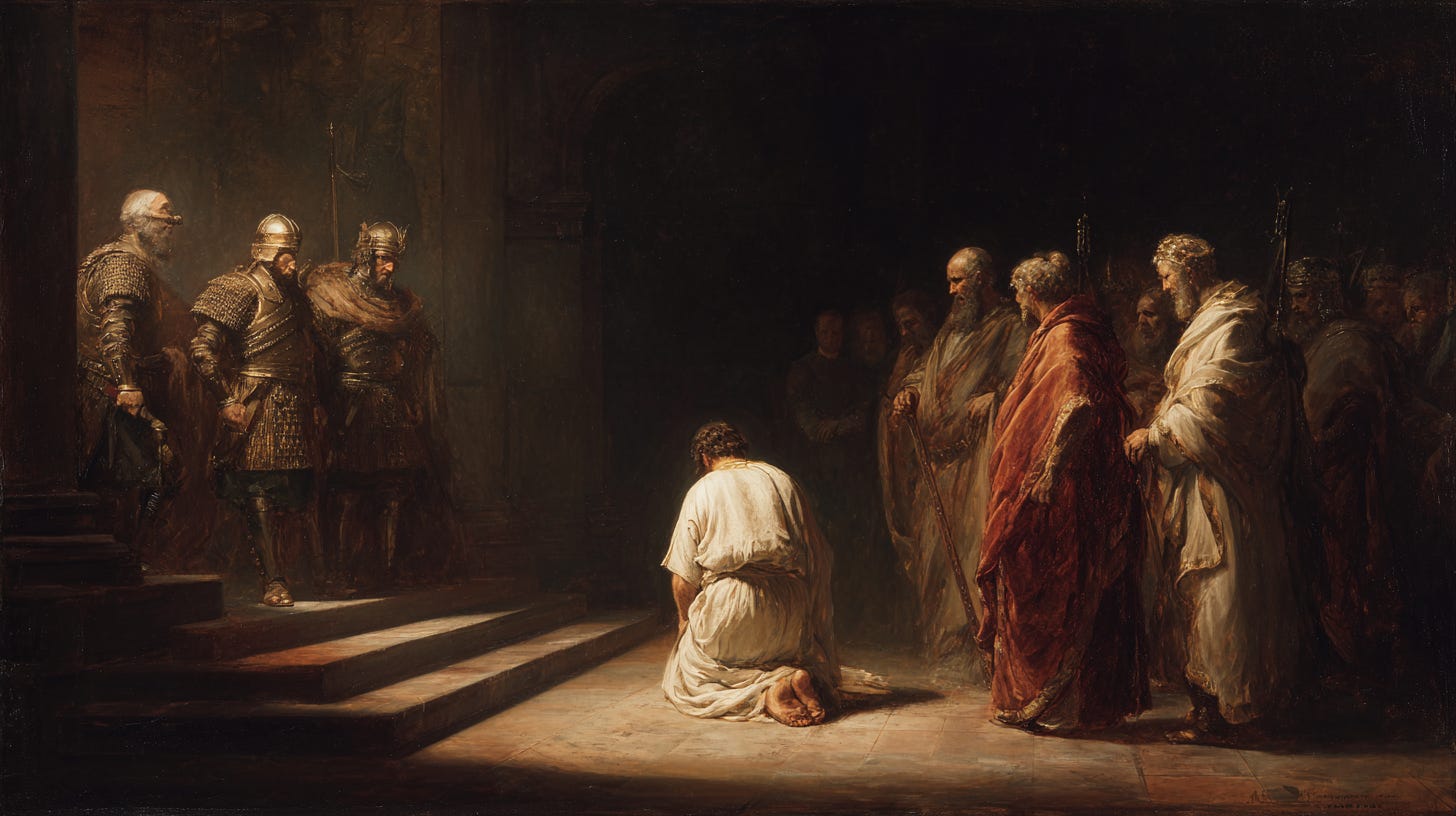
The men who put Jesus on the cross were not godless pagans acting alone.
They were religious leaders — men who knew the Scriptures, who led worship, who were entrusted with the spiritual formation of God’s people. And they were political operatives — men who understood power, managed constituencies, and knew how to work a crowd.
Together, the Sanhedrin and Pontius Pilate accomplished what neither could have done alone. The chief priests needed Roman authority to carry out the execution. Pilate needed religious cover to manage the optics. They needed each other. And so they cooperated.
The fusion of religious authority and political power condemned the Son of God to death.
Easter is five days away. I do not think we are sitting with that irony nearly enough.
The Alliance That Killed Jesus
Walk through the final hours slowly, because the details matter.
It begins with Caiaphas, the high priest, who had already concluded that one man’s death was politically preferable to national instability. “It is better for you that one man should die for the people, not that the whole nation should perish.” (John 11:50, ESV) That is not theology. That is political calculation wearing the robes of the priesthood.
The Sanhedrin — the full council of religious leaders — gathered in the middle of the night, in violation of their own legal procedures, to secure a verdict they had already decided. They were not seeking truth. They were managing an outcome.
Then they brought Jesus to Pilate. And here the choreography becomes almost unbearable to watch.
Pilate found no guilt in him. He said so — multiple times. He tried to release him. He offered the crowd a choice. He washed his hands of the whole affair, as though that settled something.
But the crowd had been prepared. The religious leaders had done their work. Public pressure, carefully cultivated, accomplished what legal process alone could not.
“Crucify him.”
And Pilate, the representative of the most powerful empire in the world, gave them what they wanted.
This is what the fusion of religion and politics produces. It does not produce righteousness. It produces Calvary.
The Kingdom Jesus Refused to Build
When Pilate finally asked Jesus directly — Are you the King of the Jews? — Jesus did not deny it. He redefined it.
“My kingdom is not of this world. If my kingdom were of this world, my servants would have been fighting, that I might not be delivered over to the Jews. But my kingdom is not from the world.” (John 18:36, ESV)
Notice what Jesus points to as the evidence: his people are not fighting. There is no political resistance movement, no armed insurgency, no coalition being assembled to seize power. Because that is not how his kingdom works.
The disciples wanted that king. They had hoped, right up until the arrest in the garden, that Jesus would call down the armies of heaven and establish the kind of kingdom they understood — one that looked like Rome, only righteous. One that held the power and used it for God.
He would not do it. Not because he lacked the power. Because that was never the kingdom he came to build.
The kingdom of God does not advance by seizing the levers of earthly power. It advances through sacrifice, through service, through the slow and costly work of lives transformed by the gospel. It looks nothing like a political movement. It looks like a man carrying a cross.
What Caesar Is Owed — And What He Is Not
When the Pharisees tried to trap Jesus on the question of Roman taxation, he looked at a coin and drew a line that has been misread ever since.
“Render to Caesar the things that are Caesar’s, and to God the things that are God’s.” (Matthew 22:21, ESV)
This is not a mandate for theocracy. It is not a blueprint for Christian governance. It is a distinction — a careful, deliberate line between two realms that are not the same.
Caesar can have his coin. He is owed civic participation, lawful obedience, the taxes that fund the roads and the courts. Christians are not anarchists. We live in communities, we vote, we serve our neighbors, we care about the health of the societies we inhabit.
But there is a boundary. Caesar cannot have our ultimate allegiance. He cannot have the pulpit. He cannot have the identity of Christ’s Church. He cannot have the gospel — to use it, to weaponize it, to drape it in a flag and march it into a political coalition.
The Pharisees thought they were honoring God when they handed Jesus to Pilate. They had convinced themselves that protecting the institution, managing the political situation, and preserving their influence was the same as faithfulness.
It was not. And the resurrection was God’s verdict on that confusion.
Our Citizenship Was Never Here
Paul wrote to the church at Philippi from a Roman prison. He knew something about the cost of holding a citizenship that Caesar did not recognize.
“But our citizenship is in heaven, and from it we await a Savior, the Lord Jesus Christ.” (Philippians 3:20, ESV)
Philippi was a Roman colony. Its residents were proud of that citizenship — it meant legal protections, social status, belonging to the empire’s inner circle. And Paul looks at that pride and says: you have something better. You belong to a different city entirely. You are waiting for a different King.
That is not dual citizenship. That is a clear hierarchy. Heaven first. Everything else underneath.
The early church understood this viscerally, because the cost of confessing Jesus is Lord was the implicit denial of Caesar is Lord. Those two statements could not coexist. The Roman world knew it. The Christians knew it. That is why they died in the arenas.
We have largely forgotten that the confession was ever costly. And in forgetting the cost, we have begun to blur the line.
When the language of kingdom and the language of nation become indistinguishable — when the flag and the cross are treated as the same symbol, when political victory is celebrated as spiritual vindication — we are not honoring our earthly citizenship. We are betraying our heavenly one.
The Irony That Should Stop Us Cold
Here is what I cannot get past this Holy Week.
The impulse to fuse religious authority with political power — whatever the intentions of those drawn to it, whatever the genuine faith motivating them — is reaching for exactly the thing that condemned Jesus. The use of faith to sanctify a political agenda. The belief that God’s purposes and national purposes are the same thing. The conviction that the church’s influence is best measured by its access to earthly power.
The Sanhedrin believed that too. They were wrong in a way that cost them everything.
I am not saying that everyone who wants the church to engage the culture is a Pharisee. Faithful civic engagement is not the problem. The problem is when religious identity becomes so entangled with political identity that the two can no longer be separated — when the church’s voice in the public square sounds less like the gospel and more like a party platform.
That is the pattern Scripture warns against. That is the pattern that handed Jesus to Pilate. And that is the pattern the resurrection declared finished — even if the world keeps trying to rebuild it.
We are not of this world. If we believe that — if we actually believe it — the question is not how much political power the church can accumulate. The question is why we want it at all, and what we are willing to sacrifice to get it.
What I Have Watched in the Boardroom
I want to be careful here. I am not naming individuals or specific churches. I am describing a pattern.
I have sat in elder board rooms where the political temperature of the congregation was a factor in ministry decisions. Where a pastor’s perceived political alignment mattered to the board’s confidence in his leadership. Where raising a question that cut against the assumed political consensus in the room landed with a discomfort that had nothing to do with Scripture and everything to do with tribal loyalty.
I have watched good boards fracture not over theology — not over the gospel, not over the nature of Christ, not over the authority of Scripture — but over the culture war. Over whose side we are on. Over whether the church is going to be a safe place for people who vote differently, think differently, come from different places.
And I have watched what happens to the flock when that fracture becomes visible. People leave quietly. Wounded people lose faith — not in Christ, but in the institution that was supposed to point them to him. Young people look at what the church has become and conclude it is not for them.
This is a shepherding failure. And it has a cost that does not show up on any budget report.
The Prophetic Voice the Church Is Trading Away
The prophets of Israel were not court chaplains. They did not exist to bless the king’s agenda. They stood before power and said: This is what God requires. And you are not doing it.
Nathan confronted David. Elijah confronted Ahab. Jeremiah confronted Jerusalem itself — and was imprisoned for it. The prophetic tradition in Scripture is not one of religious leaders baptizing political power. It is one of God’s servants standing outside that power and speaking truth to it.
That is what a healthy church is called to be. Not a mirror of the culture. Not a chaplain to political movements. A community that lives by different rules, embodies different values, and speaks an inconvenient truth to a watching world — regardless of who is in power, regardless of which party benefits from the truth being told.
When the church trades that witness for political influence, it makes a catastrophic bargain. It gains access to the table and loses the only thing it had worth saying.
The Sanhedrin had access to the table. They had Pilate’s ear. They got what they wanted on that Friday afternoon.
And three days later, everything they had protected was obsolete.
Easter Is the Answer
The resurrection is not a footnote to the kingdom argument. It is the argument.
Every earthly kingdom operates on the assumption that death is the final threat — that the power to kill is the ultimate power. Rome ruled an empire on that assumption. The Sanhedrin leveraged it. Pilate exercised it.
And on the third day, Jesus walked out of the grave.
The kingdoms of this world did their worst. They brought the full weight of religious authority and political power to bear on one man — and it did not hold. The stone was rolled away not by an army, not by a political movement, not by a coalition that had finally accumulated enough power. By God. Who was never impressed by Caesar’s legions or the Sanhedrin’s robes.
“But our citizenship is in heaven, and from it we await a Savior, the Lord Jesus Christ.” (Philippians 3:20, ESV)
We are not waiting for a political party to save the church. We are not waiting for the right candidate, the right majority, the right cultural moment. We are waiting for the King who already won — who proved on Easter morning that his kingdom operates by entirely different rules than the ones this world runs on.
Hold that citizenship. It cost him everything to secure it.
He is risen. That is still the only answer that matters.
For Leaders Specifically
If you serve on an elder board, one question deserves an honest answer.
When your board makes decisions — about staff, about ministry direction, about how to engage with cultural controversy — what is actually driving those decisions? Biblical qualification and gospel faithfulness? Or the political temperature of the congregation?
An elder board that functions by political calculation is not protecting the flock. It is managing a constituency. That is not eldership. That is the Sanhedrin.
The standard is character. Godliness. A life that commends the gospel. Those have nothing to do with party affiliation and everything to do with the One whose Church this actually is.
The Shepherd has not abdicated. His kingdom has not been threatened by any election, any administration, or any cultural moment. He is building his Church — and the gates of hell, let alone any political coalition, will not prevail against it.
Serve him. Not the moment.
Randy has served as a lay elder and elder board chairman in evangelical churches for more than 23 years. Wounded Shepherd exists to encourage Christ followers and to help local church leaders recover biblical faithfulness. Content is drafted with AI assistance; the theology, convictions, and personal experience are Randy’s own
.