
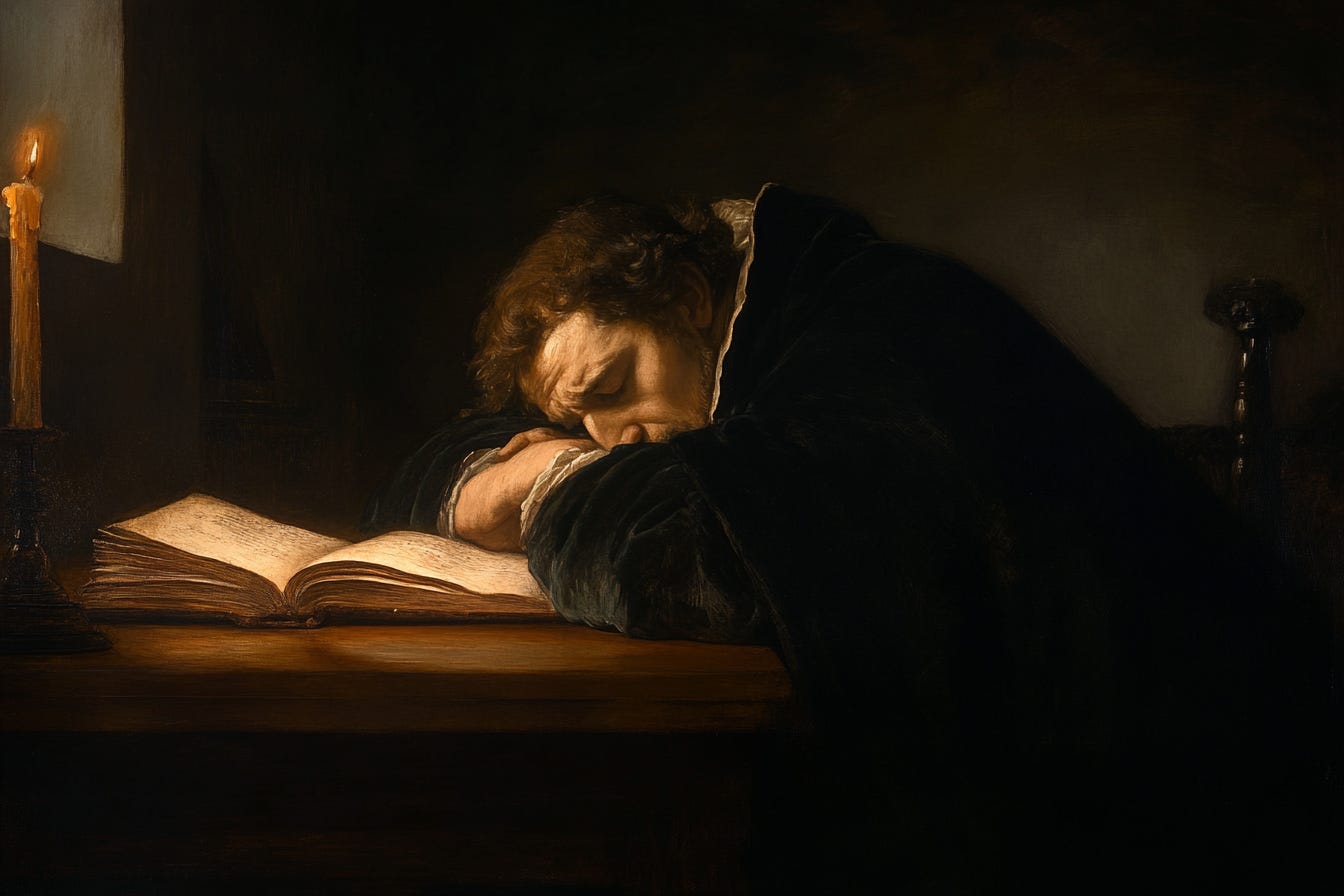
The local church is a hospital where Christ continues His healing work among His own.
The phrase “hospital for sinners” gets used so often it has lost its precision. Strictly speaking, the local church is not a public hospital with revolving-door admissions. It is the household of those who have come to the Great Physician and are still being healed by Him. The patients in this hospital are His patients. The medicine is His medicine. The Physician is Christ Himself, and we who are in the room are there because He has received us.
That changes the picture, but it does not soften it. Inside the assembly of those who are already in Christ, sin is still real. The shepherd who has been forgiven still drifts. The brother who has been received still wanders. The sister who has been bandaged still bleeds again. The local church is the place where Christ keeps doing the long, slow work of healing the people He has called His own. It is where sin is named honestly and forgiveness is offered without flinching. It is where people who have already been received walk in carrying something they cannot fix on their own and hear, from another forgiven sinner, that the Great Physician is still in the business of healing.
That is the work. That is the calling. That is what the local church is for.
But this hospital stops functioning under one specific condition.
It stops functioning when the doctors Christ has placed in the room are themselves sick and no one is allowed to say so.
The patients still come. The diagnoses still get written. The charts are still kept. From the outside, the institution looks like it is doing its job. But the medicine being prescribed is medicine the doctors are not taking themselves. The diagnoses being offered come from men whose own conditions have gone undiagnosed for years. And the rule of the place, however it came to be, is that no one questions the physician.
That is where I want to spend our time today. Not on the wolves we talked about last week. Wolves were never the shepherd Scripture describes. They came in from outside, or rose up from within, but they were never walking faithfully. The men I want to talk about today were.
They were genuine elders. They were called. They were qualified, at one time, by the standards of 1 Timothy 3 and Titus 1. They prayed honestly, taught faithfully, loved the flock. And then, somewhere along the way, something started to go wrong.
It does not always look like sin in the dramatic sense. Sometimes it is drift. The man who started his eldership in the Word now spends his Tuesday nights on budgets and building issues and never quite finds his way back. Sometimes it is burnout. The shepherd who once carried the flock with joy now carries it with resentment, and cannot remember when the change happened. Sometimes it is pride. Years of being deferred to have done what they always do. Sometimes it is bitterness, slowly accumulated from being misunderstood or unappreciated, that has hardened into a posture the man no longer notices. Sometimes it is a private sin that has not been confessed in years. Sometimes it is a marriage quietly disintegrating in a house where everyone still smiles on Sunday morning.
The point is not the specific illness. The point is that the doctor is sick. And in too many local churches, no one is allowed to name it.
I will tell you plainly that I have been one of those men. Not in the dramatic ways. In the slower, quieter ways. There were seasons in my eldership where I would have failed an honest assessment, and I knew it, and I kept going. I kept teaching. I kept counseling. I kept sitting at the table making decisions that affected people’s lives, and the deepest parts of my own life had not been examined by another elder in a long time. I was the doctor. I was also sick. And the structures around me were not built to notice.
That is what I want elders to hear this week. This is not an article about the men over there. This is an article about us.
What Scripture Already Knows
God knows about sick shepherds. Ezekiel 34 is the Old Testament’s clearest indictment of them, and it does not pull punches. “Ah, shepherds of Israel who have been feeding yourselves! Should not shepherds feed the sheep? You eat the fat, you clothe yourselves with the wool, you slaughter the fat ones, but you do not feed the sheep. The weak you have not strengthened, the sick you have not healed, the injured you have not bound up, the strayed you have not brought back, the lost you have not sought, and with force and harshness you have ruled them.”
Read that slowly. Every clause is a diagnosis. The sheep are not being fed. The sheep are not being healed. The strayed are not being recovered. And the reason, in every clause, is that the shepherds have turned inward. They are feeding themselves. They are clothing themselves. The flock has become a means rather than an end.
Ezekiel does not say these men are wolves. He says they are shepherds who have stopped doing what shepherds do. They are still in the role. They still have the staff in their hand. They are simply no longer healthy enough to use it for the sheep’s good.
The next thing God says is the part I want elders to sit with. “Therefore, thus says the Lord God to them: Behold, I, I myself will judge between the fat sheep and the lean sheep.” God does the judging. He does it because the shepherds will not. And then, finally, the promise: “I myself will be the shepherd of my sheep, and I myself will make them lie down, declares the Lord God.”
The Chief Shepherd does not abandon the sheep when the under-shepherds fail. He intervenes. That is good news. It is also the whole reason this conversation is worth having. If God were indifferent to sick shepherds, none of this would matter. The fact that He is not indifferent is exactly why elder boards are answerable for the spiritual health of their members.
Three Things a Sick Doctor Cannot Do
A sick doctor cannot diagnose well. His own condition shapes what he sees in everyone else. The elder fighting unconfessed sin will instinctively soften the call to repentance in the men he counsels, because to call others to it sharply is to indict himself. The elder who has grown bitter toward his pastor will read every disagreement in the room as another instance of the same offense. The elder running on fumes will mistake his own exhaustion for the congregation’s apathy. He is not lying. He is reporting what he sees. The problem is what he is seeing through.
A sick doctor cannot prescribe what he is not taking. This is the one elders feel in their bones if they let themselves. You cannot, with any spiritual authority, call a man to confess what you have not confessed. You cannot call a marriage to fight for itself when you have stopped fighting for yours. You cannot call the flock to abide in Christ from a season in which you have not abided in Him in months. The words come out. The words even sound right. But there is no power in them, and the people you are speaking to can usually tell, even when they cannot say why.
A sick doctor needs another doctor. This is the one we resist most. Elders, of all people, find it difficult to be the patient. The role gets internalized. The role becomes the identity. To sit across from another elder and say, I am not well, and I need help, is to relinquish the only posture some of us know how to hold.
But no responsible doctor diagnoses himself. Even the best physicians, when they get sick, go to someone else. They sit on the table, not behind the desk. They answer the questions. They follow the instructions. They submit to a process they cannot run on themselves. And the reason is not weakness. The reason is that diagnostic distance is a real thing. You cannot see your own back. You cannot listen to your own heart with a stethoscope. You need another set of hands and another set of ears.
Elders need that, too. Not occasionally. Not in crisis. Routinely. As a matter of course. As part of what it means to hold the office at all.
The Redemptive Turn
Scripture does not leave sick shepherds without a path back. The path is named, and it is gentle, and it is one of the most beautiful passages in the New Testament for a man who has lost his footing.
James 5:13-16, ESV:
Is anyone among you suffering? Let him pray. Is anyone cheerful? Let him sing praise. Is anyone among you sick? Let him call for the elders of the church, and let them pray over him, anointing him with oil in the name of the Lord. And the prayer of faith will save the one who is sick, and the Lord will raise him up. And if he has committed sins, he will be forgiven. Therefore, confess your sins to one another and pray for one another, that you may be healed. The prayer of a righteous person has great power as it is working.
Notice what James assumes. He assumes a body of believers in which sickness, both physical and spiritual, is named honestly. He assumes the sick person calls for help. He assumes the elders come, and pray, and confess their own sins as well, and the healing happens in that mutual confession.
Now ask the harder question. Who calls for help when the sick one is the elder?
That is the diagnostic question this passage opens up. James writes as though the elder is the one being called, and that is right. But the same elder who is called to the bedside of the sick member of the flock is himself a man who can grow sick. And the structure of James 5 implies that what is true for the member is true for the shepherd. The healing happens through naming. The healing happens through confession. The healing happens in the room where another brother prays the prayer of faith over a man who has admitted he needs it.
Galatians 6:1 says the same thing in different language. “Brothers, if anyone is caught in any transgression, you who are spiritual should restore him in a spirit of gentleness. Keep watch on yourself, lest you too be tempted.” Restoration, not removal, is the first impulse. Gentleness is the manner. Self-watchfulness is the safeguard. And the entire posture assumes a community in which transgressions can be named without immediate disaster.
This is the way out for sick shepherds. It is not termination. It is not exposure. It is not public shaming. It is the same path Scripture offers every other forgiven sinner in the household: confession, prayer, the prayer of faith, the slow restoration of a brother in gentleness.
But it requires one thing first. It requires a structure in which an elder can be named as sick.
What This Means for Elder Boards
Here is the question that has stayed with me all week, and that I want to leave with you:
Can your elder board name an elder as spiritually sick?
Not in theory. In practice. If one of your elders is drifting, can the others say so to him? If one is burning out, can the room name it without it being received as an accusation? If one has hardened into pride or bitterness or quiet despair, is there a process by which that gets surfaced and walked through?
In most local churches, the answer is no. The board has procedures for almost everything except the spiritual health of its own members. There is a budget process. There is a building process. There is a search process for new elders. There is a discipline process for members. There is no process for the men in the room.
And so the men in the room go undiagnosed for years. The doctor is sick, and the rule of the place is that no one says so, and the patients keep coming through the door, and the medicine keeps getting prescribed by men who have stopped taking it.
This is not a failure of any one elder. It is a structural failure. It is the absence of a tool the local church has needed for a long time.
So I will end where Week 8 left off, with another diagnostic question, and I will leave it open.
Who checks the doctor?
Not as accusation. As a serious ecclesiological question. If the men charged with the spiritual care of the flock are themselves men who can grow sick, and if Scripture both diagnoses that sickness in Ezekiel and prescribes its remedy in James, then the question of how the local church examines its own physicians is not a luxury. It is the precondition for everything else the local church is supposed to do.
Who checks the doctor in your church?
If you cannot name the answer, that is the answer.
May the Chief Shepherd, who promised in Ezekiel 34 to shepherd His sheep Himself, give us the courage to be honest about our own health. And may He raise up among us the kind of brother elders who can hold us when we cannot hold ourselves.
#WoundedShepherd