
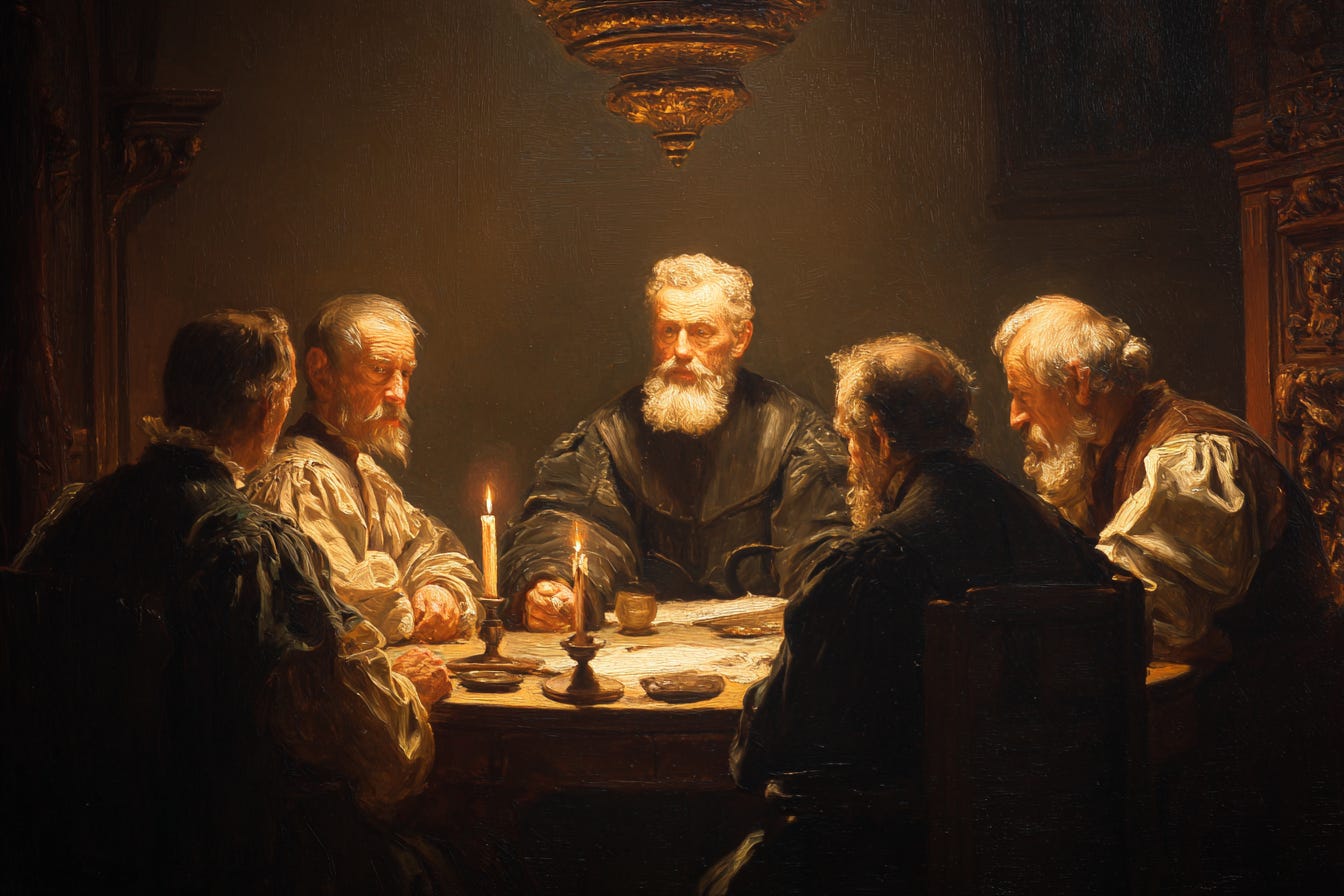
No single man was meant to carry this alone.
I’ve sat in a lot of elder meetings.
Some of them were genuinely life-giving — men wrestling together over Scripture, carrying real burdens for real people, holding one another accountable in ways that made the whole board stronger. A few of those conversations still stay with me as some of the best I’ve ever had about what it means to follow Christ.
And some of those meetings were something else entirely. Rooms where one voice dominated. Where questions were discouraged. Where the unspoken rule was that the pastor had already decided, and the elders were there to confirm it.
I’ve experienced both. And the difference wasn’t just in how those rooms felt. The difference showed up in how those churches held up under pressure.
The Question Nobody Asks Before It’s Too Late
Most churches spend a lot of energy finding the right pastor. And that’s understandable — the teaching ministry of a church matters enormously. A pastor who handles Scripture faithfully, loves his people, and models Christ-like character is a genuine gift.
But here’s the question I rarely hear churches ask before things go wrong: What happens when the pastor struggles?
What happens when he burns out? When his marriage hits a crisis? When he loses perspective, or begins to drift theologically, or starts making decisions that would benefit from outside correction? What happens if he’s simply wrong about something important?
In a church where the pastor is essentially the sole authority — where the elder board functions more as a support structure than a genuine plurality of leadership — the answer to those questions is often: nothing. Or worse, something ugly.
I’ve watched it happen. Not in some distant cautionary tale, but in the rooms where I was sitting.
What the New Testament Actually Establishes
The pastoral model most of us grew up with — one primary leader, a board that defers — isn’t what the New Testament describes. It’s a cultural inheritance, largely shaped by the CEO model of American institutional life. It’s not wrong because pastors are bad people. It’s wrong because it concentrates authority in a way Scripture never intended.
Look at what Paul tells Titus: “This is why I left you in Crete, so that you might put what remained into order, and appoint elders in every town as I directed you” (Titus 1:5, ESV). Plural. Every town, a plurality of leaders.
In Acts 20, Paul doesn’t call for the pastor of Ephesus to come to him at Miletus. He calls for the elders — the same men he refers to interchangeably as overseers and shepherds in the verses that follow. “Pay careful attention to yourselves and to all the flock, in which the Holy Spirit has made you overseers, to care for the church of God, which he obtained with his own blood” (Acts 20:28, ESV).
Peter echoes this when he writes to his fellow elders — not to pastors as a distinct, elevated category, but to the plurality of men entrusted with the oversight and care of the flock (1 Peter 5:1-3, ESV).
The New Testament pattern is consistent: shared authority, shared responsibility, shared accountability. No single human being carrying the weight that only Christ is designed to bear.
The Difference It Makes in Real Life
I’ve served under both models. I want to be careful here — this isn’t about blaming individuals. I’ve known pastors in single-leader structures who were genuinely humble and would have welcomed more accountability if the culture had invited it. And I’ve been in a plurality that still failed, because plurality without genuine accountability is just a larger concentration of the same problem.
But I can tell you what the difference felt like in practice.
In a healthy plurality, when I raised a concern, it went somewhere. Other voices engaged it. We weighed it together. Sometimes I was wrong, and other men helped me see that. Sometimes I was right, and the board’s collective discernment confirmed it. The process itself was a form of protection — for the church, for the pastor, for all of us.
In a single-leader model, when concerns surfaced, they often hit a wall. Not because anyone was malicious, but because the structure had no real mechanism for processing them. There was no plurality to turn to. There was the pastor, and there was everyone else.
The vulnerability isn’t theoretical. It’s structural. And it shows up whenever pressure arrives.
Why This Matters for Your Church Right Now
You may be reading this and thinking: Our pastor is great. This doesn’t apply to us.
I hope that’s true. But I’d gently ask: how would you know?
If your church operates with a single primary authority and an elder board that largely defers to that authority, the honest answer is that you might not know — until something goes wrong. And by then, the cost is almost always higher than it needed to be.
A healthy elder board isn’t a check on a pastor who’s failing. It’s a gift to a pastor who’s faithful. It distributes the weight of leadership so that no one man is expected to carry what no one man can carry. It creates relationships of genuine mutual accountability that protect everyone — the pastor, the elders, and the congregation they’re called to serve.
The question isn’t whether your pastor is good. The question is whether your leadership structure is healthy enough to sustain a long ministry — and honest enough to address it when something goes wrong.
A Thought to Sit With
I’ve been in enough churches to know that most elder boards don’t do a regular, honest assessment of their own health. They evaluate programs. They review budgets. They discuss staff. But they rarely ask: How are we doing as a board? Are we actually functioning as a biblical plurality? Is there anything in our culture or our structure that’s leaving us — and our pastor — exposed?
Those questions don’t come naturally. They require intentionality. And they’re almost always worth asking before a crisis forces them.
In the coming weeks, I’ll be writing more about what a healthy elder board actually looks like — how it functions, how it self-examines, and what it takes to move from a structure that looks biblical on paper to one that’s genuinely healthy in practice. If those questions resonate with you, I’m glad you’re here.
“Pay careful attention to yourselves and to all the flock, in which the Holy Spirit has made you overseers, to care for the church of God, which he obtained with his own blood.” (Acts 20:28, ESV)
A Prayer for Today
Father, thank You that Your Church belongs to You — not to any pastor, any elder, any board. Where leadership structures have drifted from Your design, give Your people wisdom and courage to ask hard questions. Protect faithful pastors from the weight of authority no one should carry alone. Raise up elders who lead with humility and serve with genuine care. And guard Your flock with the attentiveness that only You can provide. In Jesus’ name, amen.
If this is your first time here, Wounded Shepherd is a space for honest conversation about biblical leadership — written by someone who’s learned most of what he knows the hard way. I’ve served as a lay elder for 23 years across several churches, including a season as elder board chairman that ended when I pursued accountability for a pastor who didn’t welcome it. I write from that place — not with bitterness, but with the hope that what I’ve lived through might help someone else navigate it better.
New here? [Subscribe to get future articles delivered to your inbox.]